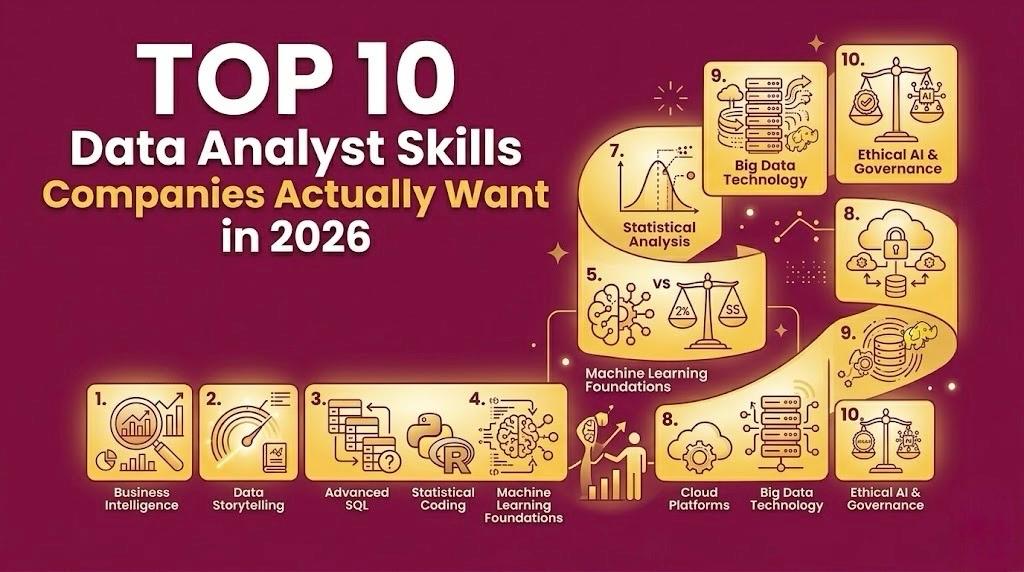
The expectations from data analysts are changing faster than ever. Companies are no longer hiring professionals who only know tools like Excel or SQL. Instead, they are looking for analysts who can translate data into business insights, support decision-making, and contribute directly to growth. This shift has made understanding the Top 10 Data Analyst Skills for 2026 a critical focus for students, career switchers, and working professionals aiming to stay relevant.
In today’s AI-driven business environment, organizations value analysts who combine technical expertise with business understanding and strategic thinking. Employers want professionals who can work with data, identify patterns, communicate insights clearly, and adapt to new technologies shaping modern analytics workflows.
Understanding which skills truly matter can help you avoid random learning and focus on capabilities that improve employability and career growth. In the sections below, we will explore the core technical skills, business capabilities, and emerging AI-driven competencies that companies actually expect from data analysts in 2026.
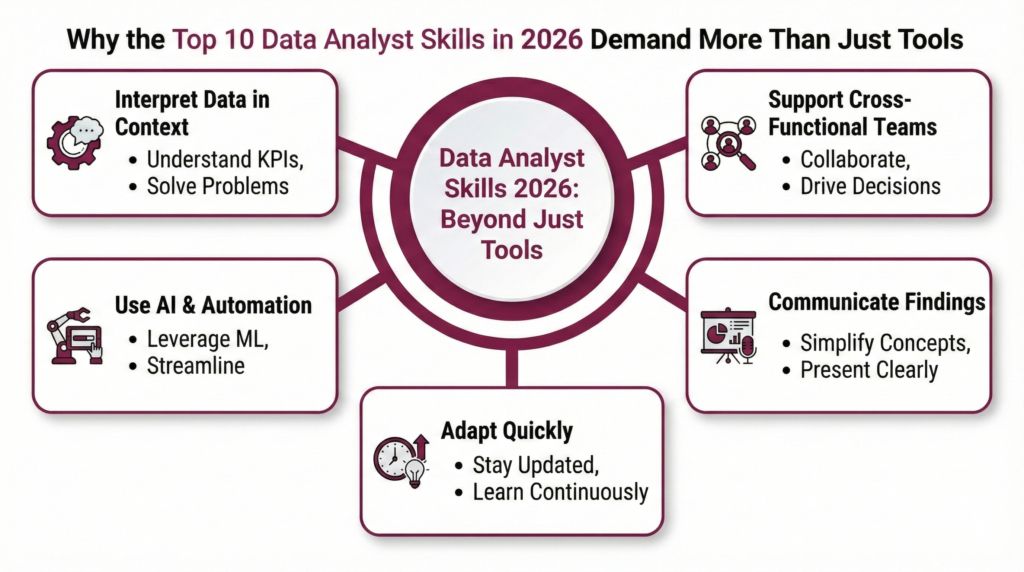
The role of a data analyst has evolved from report generation to strategic decision support, redefining what companies expect in the Top 10 Data Analyst Skills. In 2026, companies expect analysts to move beyond spreadsheets and dashboards and actively contribute to business outcomes. Knowing a tool is no longer enough understanding how that tool creates business value is what truly matters.
According to industry discussions around top skills, hiring managers increasingly prioritize analytical thinking, communication, and adaptability alongside technical proficiency. This reflects a broader shift toward outcome-driven hiring, where skills are evaluated based on real-world application rather than certifications alone.
Modern organizations now expect analysts to:
The transition from “tool operator” to “business enabler” defines the new benchmark reflected in the Top 10 Data Analyst Skills companies prioritize in 2026. Professionals who align their learning with this shift position themselves as strategic assets rather than entry-level support roles.
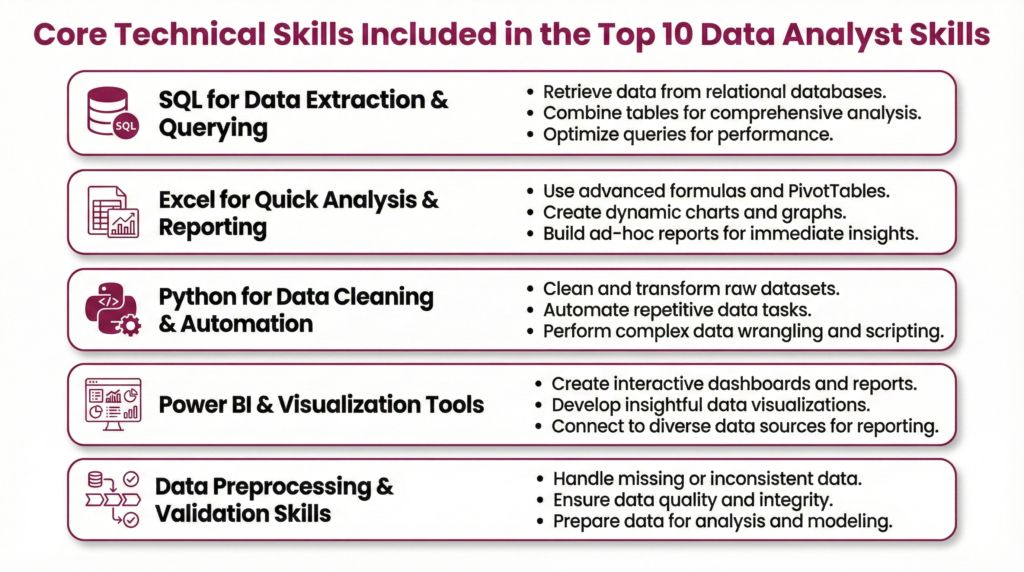
Strong technical foundations form a major part of the Top 10 Data Analyst Skills required for any data analyst role in 2026. While business understanding and communication skills are gaining importance, companies still expect analysts to handle data efficiently, build dashboards, and generate accurate insights. Technical expertise forms the base that data analyst skills for jobs enables analysts to deliver reliable and scalable analysis.
However, recruiters are no longer impressed by basic tool familiarity alone. They assess how effectively candidates use tools to solve business problems, automate workflows, and improve reporting accuracy. A balanced technical stack allows analysts to move beyond manual reporting and support real-time decision-making across teams.
These technical abilities represent a significant portion of the Top 10 Data Analyst Skills hiring managers prioritize:
While SQL, Python, and BI tools are considered core technical skills, recruiters evaluate depth, not just familiarity. Knowing syntax is different from using these tools to solve business problems. Hiring managers often review portfolios, case studies, and project explanations to assess how effectively candidates apply their skills in real-world scenarios.
Based on common resume skills insights, candidates who demonstrate measurable outcomes - such as improving reporting accuracy, automating repetitive tasks, or identifying revenue-impacting insights - gain a clear advantage during interviews.
Here’s what truly matters in hiring:
This end-to-end capability strongly aligns with the Top 10 Data Analyst Skills that define job-ready professionals in 2026. This end-to-end capability demonstrates job readiness and reduces training time for employers, making such professionals highly valuable in 2026.
Technical expertise helps you enter the analytics field, but business and analytical skills determine how fast you grow. Companies in 2026 are prioritizing analysts who can interpret top data analyst skills in a business context and support strategic decision-making. This shift has made analytical thinking and communication data analyst skills for jobs just as important as technical proficiency. These competencies expand the Top 10 Data Analyst Skills beyond technical tools and into strategic business impact.
According to industry insights on in demand skills, organizations now value professionals who can translate complex data into clear, actionable recommendations. Analysts who understand business goals and stakeholder expectations often stand out more than those who only focus on tools.
Key business-oriented skills companies expect include:
For those preparing for analytics roles, reviewing common career concerns in student FAQs can help clarify expectations around skill development and job readiness. Data analyst skills for jobs Analysts who combine technical strength with business awareness become valuable decision-support partners rather than just report creators.
The analytics landscape is reshaping how the Top 10 Data Analyst Skills are defined in 2026 Automation platforms. In 2026, companies expect data analysts to understand how AI integrates with data workflows. Data analyst skills for jobs While analysts are not required to become machine learning engineers, they must be comfortable working alongside intelligent systems.
Modern hiring trends show that analysts who understand automation and AI-assisted analytics adapt faster to evolving business environments. Technical depth combined with AI awareness increases long-term career stability and growth potential.
Emerging skills that define AI-ready analysts include:
| Area | Traditional Analyst | AI-Ready Analyst | Career Advantage |
|---|---|---|---|
| Reporting | Manual dashboards | Automated insights | Faster delivery |
| Analysis Approach | Reactive | Predictive | Strategic value |
| Tool Usage | Standalone tools | AI-integrated tools | Higher efficiency |
| Decision Support | Historical data | Real-time insights | Business impact |
Practicing real interview scenarios for mock interviews can also help analysts prepare for AI-focused hiring discussions in 2026.
Many aspiring data analysts struggle to move beyond entry-level roles not because of a lack of effort, but because of misaligned skill development. Learning tools without understanding how they solve business problems often leads to limited career growth. Companies in 2026 are prioritizing job-ready professionals who can deliver outcomes, not just complete tasks.
One common gap is focusing only on technical tutorials without working on real-world datasets or business scenarios. Analysts who cannot demonstrate practical application during interviews often find it difficult to stand out. Another major issue is weak communication - being able to analyze data is valuable only when insights can be explained clearly to decision-makers.
Typical skill gaps that slow career progression include:
Addressing these gaps requires a structured approach to skill building. Analysts who focus on practical implementation, business understanding, and continuous improvement are more likely to transition from entry-level roles to high-growth analytics positions.
Building data analyst skills in 2026 requires more than completing random courses or tutorials. A strategic learning approach helps you focus on skills that directly improve employability and long-term career growth. Instead of trying to learn everything at once, successful analysts follow a structured roadmap aligned with industry expectations.
Start by mastering core technical tools such as SQL, Excel, Python, and visualization platforms. Once the foundation is strong, shift your focus toward business understanding and real-world project execution. This combination ensures that your skills are not only technically sound but also relevant to business decision-making.
A strategic skill-building approach should include:
Consistency and practical exposure play a major role in career growth. Analysts who focus on structured learning, measurable outcomes, and continuous improvement are better positioned to secure high-quality roles and adapt to evolving analytics technologies in the coming years.
The Top 10 Data Analyst Skills in 2026 go far beyond basic tool knowledge. Companies are looking for professionals who can combine technical expertise, analytical thinking, and business understanding to deliver meaningful insights. Building the right mix of skills is no longer optional - it is essential for staying competitive in an AI-driven job market.
By focusing on core technical capabilities, strengthening business and communication skills, and staying updated with emerging AI-driven competencies, aspiring analysts can position themselves for long-term success. In demand data analyst skills a structured approach to skill development ensures that every effort contributes directly to employability and career growth.
Professionals who invest in practical learning, portfolio building, and continuous upskilling are more likely to secure high-quality opportunities and faster salary growth. In 2026 and beyond, the most successful data analysts will not be those who know the most tools, but those who know how to use their skills to solve real business problems and create measurable impact.
Understanding the Data Analyst Skills 2026 companies expect is the first step. The next step is building those skills in a structured, practical way that makes you job-ready. Employers are increasingly hiring professionals who can demonstrate real-world project experience, strong analytical thinking, and the ability to work with modern analytics and AI-driven tools.
If you want to move beyond theoretical learning and develop skills aligned with current hiring expectations, a structured learning path can make a significant difference. The right guidance helps you focus Top 10 Data Analyst Skills on industry-relevant tools, build a strong portfolio, and prepare for real interview scenarios that companies use during hiring.
To gain practical exposure and develop job-ready analytics skills, explore the Certification in AI Powered Data Analytics and start building the expertise companies are actively looking for in 2026.