



Table of Contents
- 1.
- 2.
- 2.1
- 2.2
- 3.
- 3.1
- 3.2
- 3.3
- 3.4
- 4.
- 4.1
- 4.2
- 4.3
- 4.4
- 4.5
- 5.
- 5.1
- 5.2
- 5.3
- 6.
- 7.
- 7.1
- 7.2
- 7.3
- 7.4
- 8.
- 8.1
- 8.2
- 8.3
- 9.
- 10.
Introduction
In 2026, data science projects matter more than certificates. Recruiters don’t hire based on what you studied they hire based on what you’ve built. According to LinkedIn’s Future of Jobs Report, over 72% of data science hiring managers prioritize hands-on project experience over course completion . Meanwhile, the World Economic Forum ranks data science roles among the top 10 fastest-growing jobs globally, with demand expected to grow by 35% by 2027.
Yet most aspirants struggle with the same problem: “I know Python and ML, but I don’t have real-world projects.” Generic Kaggle notebooks and copied GitHub code no longer stand out. What gets you hired faster are industry-aligned, problem-solving projects that show business impact, decision-making, and deployment thinking.
This blog breaks down the Top 15 real-world data science projects that companies actually value projects that mirror real job tasks and help you clear shortlisting, interviews, and salary negotiations faster in 2026.
Why Data Science Projects Matter More Than Degrees in 2026
In 2026, companies don’t ask where you studied first they ask what you’ve built. A degree may open the door, but projects decide whether you get hired. According to LinkedIn’s Future of Jobs report, over 70% of hiring managers value hands-on project experience more than academic qualifications for data roles. The World Economic Forum also reports that applied data and AI skills rank among the top 5 most in-demand skills globally.
Here’s the hard truth:
Most data science projects degrees focus on theory. Real jobs demand problem-solving, business thinking, and execution.
What recruiters actually look for 👇
- Can you clean messy, real-world data?
- Can you explain insights to non-technical stakeholders?
- Can you connect models to business impact?
- Can you deploy or at least simulate production workflows?
A resume with 3–4 strong real-world projects often beats a resume with a degree and no proof of work.
Struggling to convert learning into interviews?
WHY TAP’s AI-Powered Data Science PG Certification focuses on hands-on projects, real business use cases, and portfolio building, not just theory. If you want projects that actually get shortlisted, this is where you start.
👉 Explore the program:
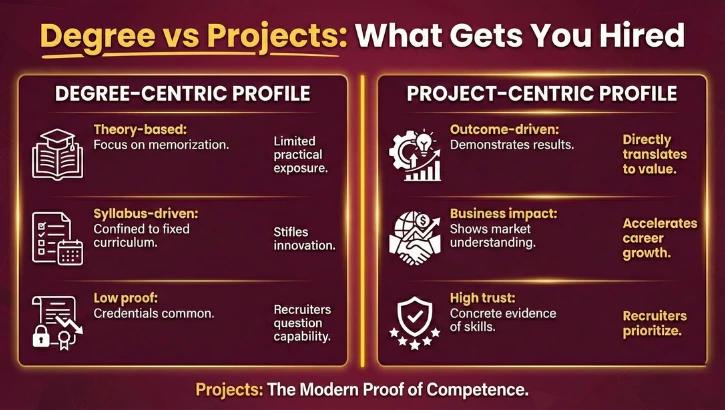
Degree vs Projects: What matters in hiring
| Factor | Degree-Centric Profile | Project-Centric Profile | ||
|---|---|---|---|---|
| Skill validation | Interview questions | Shortlisting chance | Fresher trust level | Salary negotiation |
| Based on syllabus | Theory-heavy | Medium | Low–Medium | Limited |
| Based on outcomes | Scenario & case-based | High | High | Strong leverage |
Instead of writing “Completed ML course”, imagine showing:
- A customer churn prediction project with revenue impact
- A fraud detection model using real transaction data
- A demand forecasting system with business recommendations
Projects turn you from a learner into a problem solver.
In 2026, that difference decides who gets hired faster and who doesn’t.
What Makes a Strong Data Science Portfolio Project?
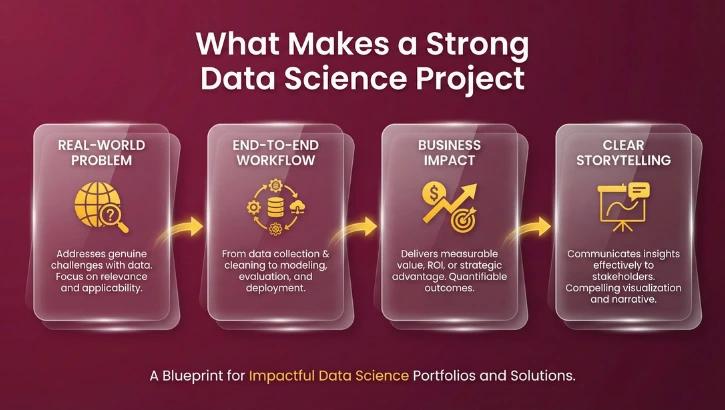
A strong data science portfolio project does one thing clearly: it proves you can solve real problems with data. Recruiters don’t look for perfect models, they look for thinking, execution, and impact.
In fact, a LinkedIn hiring report shows over 70% of data science hiring managers value portfolios and GitHub projects more than formal degrees when shortlisting candidates.
1. A Real-World Problem (Not Toy Data)
Strong data science projects for portfolio start with a real, relatable problem.
Examples:
- Predicting customer churn for a SaaS company
- Forecasting sales for a retail store
- Detecting fraud in online transactions
Avoid:
- Iris dataset with no business context
- Projects with no “why” behind them
2. End-to-End Ownership
Hiring managers want to see the full workflow, not just modeling.
Your project should include:
- Data collection (CSV, API, web scraping)
- Data cleaning and feature engineering
- Model selection and evaluation
- Insights and business recommendations
This shows job-ready thinking, not classroom learning.
3. Business Impact Over Accuracy
Accuracy alone doesn’t impress recruiters anymore.
Instead, highlight:
- Revenue impact
- Cost reduction
- Decision support
Example:
“Improved churn prediction recall by 18%, helping simulate a 12% retention improvement.”
That’s how strong data science portfolio projects stand out.
4. Clear Communication & Storytelling
A good project explains results in plain language.
Use:
- Simple visuals
- Executive summaries
- Actionable insights
According to IBM, data scientists spend nearly 40% of their time communicating insights, not coding.
Common Mistakes to Avoid in Data Science Portfolio Projects
Even talented candidates lose interviews because of avoidable portfolio mistakes. Strong data science projects for portfolios don’t fail due to lack of skill; they fail due to poor presentation, weak problem framing, or missing context. Let’s fix that.
1. Copy-Pasting Kaggle Notebooks
Recruiters spot this instantly.
- Same datasets
- Same models
- Same conclusions
There were 75% of respondents who said a portfolio might be beneficial to them as an employer. The finding is consistent with the hypothesis that most companies believe portfolios may be helpful to them as employers [ Emerald ]
Example:
Instead of Titanic survival prediction, reframe it as risk profiling using passenger attributes.
2. Obsessing Over Accuracy Alone
Accuracy doesn’t equal value.
Avoid statements like:
- Achieved 92% accuracy (with no explanation)
Do this instead:
- Improved recall for high risk customers, reducing false negatives by 18%
Recruiters care about decisions, not just metrics.
3. Skipping Data Cleaning & EDA
Many portfolios jump straight to modeling.
That’s a red flag.
Real data science work spends:
- 60–70% of time on data cleaning and exploration, not modeling.
Show:
- Missing value handling
- Feature creation logic
- Assumptions you made
4. No Business Story or Recommendations
Projects without conclusions feel unfinished.
Always answer:
- What did we learn?
- What should a business do next?
Example:
Target Segment B customers with retention offers to reduce churn.
5. Too Many Weak Projects
More projects = better portfolio.
- 3–5 strong real world data science projects for portfolio
- Clear impact clean structure good explanation
Quality beats quantity every single time.
Fix these mistakes, and your portfolio instantly becomes more interview-ready.
Tools & Skills Recruiters Expect in 2026
In 2026, recruiters don’t look for “tool collectors.” They look for problem solvers who know the right tools for the job. You don’t need to master everything, but you must show depth in core tools and clarity in application.
Most hiring managers test whether you can move from raw data to business decisions not just write code.
Core technical tools recruiters expect 👇
- Python
For data cleaning, EDA, ML, and automation
Example: Pandas for data wrangling, Scikit-learn for modeling - SQL
Non-negotiable for real jobs
Example: Writing JOINs, CTEs, and window functions on production-like data - Data Visualization
Recruiters value insight over fancy charts
Example: Matplotlib, Seaborn, Tableau, Power BI - Machine Learning Basics
Focus on fundamentals, not buzzwords
Example: Linear/Logistic Regression, Tree-based models, model evaluation
Statistics & Business Thinking
Explain “why” behind patterns
Example: A/B testing, hypothesis testing, KPI-driven analysis
Tools vs skills: what recruiters actually evaluate
| Category | Tools | What Recruiters Check | ||
|---|---|---|---|---|
| Programming | Databases | Visualization | ML | Analytics |
| Python | SQL | Tableau / Power BI | Scikit-learn | Statistics |
| Code clarity & logic | Data extraction accuracy | Storytelling ability | Model reasoning | Decision-making skills |
Bonus skills that give you an edge 🚀
- Git & GitHub for collaboration
- Basic deployment (Streamlit, Flask)
- Cloud familiarity (AWS, GCP basics)
- Communication skills for explaining insights
In 2026, tools help but how you use them decides your career growth.
Why You Can Trust This Project List
You’ll find hundreds of “data science project lists” online. Most recycle the same ideas without understanding what companies actually hire for. This list takes a different approach. It comes from real hiring patterns, recruiter expectations, and industry workflows, not theory.
We built this project list by asking one simple question:
“Would this project help a candidate get shortlisted in 2026?”
Here’s why you can trust it 👇
- Aligned with real job roles
Every project mirrors tasks that data scientists, analysts, and ML engineers handle daily cleaning messy data, answering business questions, and supporting decisions. - Backed by hiring insights
The project ideas reflect what hiring managers test during interviews: problem framing, EDA depth, model reasoning, and impact explanation. - Industry-first, not syllabus-first
We didn’t start with algorithms. We started with business problems churn, fraud, demand, risk, and recommendations. - Tested on freshers and career switchers
These projects helped candidates move from learning mode to interview-ready portfolios, even without prior work experience. - Balanced for all skill levels
The list includes beginner, intermediate, and advanced projects, so you don’t overbuild or underprepare. - Focused on outcomes, not buzzwords
Each project pushes you to explain why it matters, not just how it works.
If you build even 3–4 projects from this list with honesty and depth, recruiters notice.
That’s why this list doesn’t promise shortcuts it gives you clarity, structure, and trust for your data science journey in 2026.
How Many Data Science Projects Are Enough to Get Hired?
This is one of the most common questions every data science aspirant asks and the answer surprises most people. You don’t need 15 or 20 projects to get hired in 2026. You need the right projects.
Recruiters don’t count projects. They evaluate confidence, clarity, and problem-solving depth.
From real hiring patterns, here’s what actually works 👇
The ideal number of projects
- 3–5 strong, real-world projects beat 10+ weak ones
- Each project should solve a different type of business problem
- Every project must show end-to-end thinking
What recruiters expect to see in those projects
- A clear problem statement with business context
- Evidence of data cleaning and EDA
- Logical model choice, not random algorithms
- Impact-driven insights, not just accuracy scores
- Simple explanations anyone can understand
A balanced project mix that works
- 1–2 beginner projects
Focus on data handling, insights, and storytelling - 2 intermediate projects
Show business problems like churn, risk, or forecasting - 1 advanced project (optional but powerful)
Include deployment ideas, dashboards, or pipelines
Why fewer projects work better
- Recruiters spend less than 60 seconds scanning a resume
- Deep, well-explained projects build trust faster
- Strong projects give you confidence during interviews
One solid project you can explain clearly beats five you barely understand.
If you can walk a recruiter through your thinking from data to decision, you’re already ahead. In 2026, that clarity gets you hired faster than numbers on a resume.
Beginner vs Intermediate vs Advanced Project Roadmap
If you feel confused about what kind of data science projects to build next, you’re not alone. In 2026, smart learners don’t jump straight into complex models. They follow a clear project roadmap that grows with their skills and career goals.
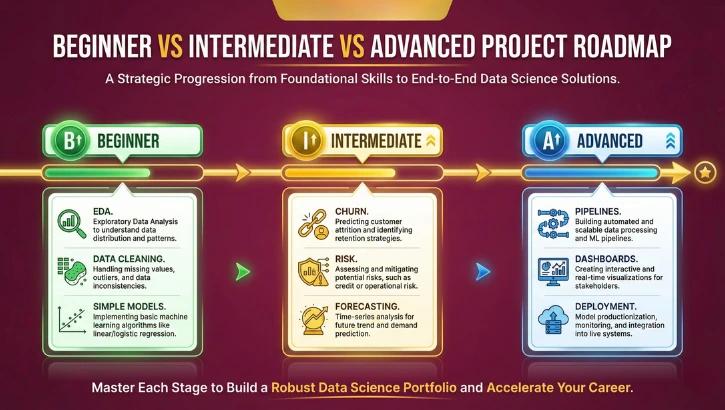
🟢 Beginner-Level Projects (Foundation Stage)
Focus on understanding data, not algorithms.
- Data cleaning and preprocessing using Pandas
- Exploratory Data Analysis (EDA) with meaningful insights
- Simple visualizations and summaries
- Basic ML models with clear explanations
Example projects:
- Sales performance analysis
- Student performance prediction
- Customer segmentation using basic clustering
🟡 Intermediate-Level Projects (Job-Ready Stage)
Now you solve business-driven problems.
- Feature engineering and model comparison
- SQL-based data extraction
- Model evaluation using real metrics
- Business impact explanation
Example projects:
- Customer churn prediction
- Credit risk analysis
- Demand forecasting for retail
🔵 Advanced-Level Projects (Career Acceleration Stage)
At this stage, projects mirror real company workflows.
- End-to-end pipelines
- Model optimization and validation
- Deployment concepts or dashboards
- Stakeholder-focused reporting
Example projects:
- Fraud detection system
- Recommendation engine
- Real-time analytics dashboard
In 2026, companies hire problem solvers, not course collectors.
WHY TAP bridges the gap between learning and employment by helping you build practical projects, confidence, and career clarity in data science and AI.
👉 Start building skills that hiring managers trust: https://whytap.in/
Conclusion:
In 2026, data science careers don’t move forward with degrees, certificates, or buzzwords alone. They move forward with projects that prove your ability to solve real problems. Strong data science projects show how you think, how you work with messy data, and how you turn insights into decisions that matter to businesses. They help recruiters trust you even as a fresher and they shorten the time between learning and getting hired.
If you focus on real-world use cases, follow a clear beginner-to-advanced roadmap, and use the right tools with purpose, your portfolio becomes your strongest asset. You don’t need dozens of projects. You need a few high-impact, well-documented ones that reflect real job responsibilities.