




Table of Contents
- 1.
- 2.
- 3.
- 3.1
- 4.
- 5.
- 6.
- 7.
- 8.
- 9.
- 10.
- 11.
- 12.
- 13.
Many students complete a data science course, build a few projects, and confidently start applying for jobs. On paper, everything looks strong: Python, SQL, machine learning models, and dashboards. Yet, after multiple interviews, rejection emails start piling up. This pattern explains why data science students struggle in interviews despite having technical knowledge and certifications.
The problem is rarely about intelligence or effort. It is about alignment. Interviews today test practical thinking, business understanding, and real-time problem-solving, not just theoretical answers. Recruiters want to see how candidates approach ambiguity, justify decisions, and communicate insights clearly. When preparation focuses only on tools instead of application, gaps become visible quickly.
To understand this clearly, we will see a brief breakdown of the real reasons, common mistakes, industry expectations, and structured preparation strategies in the below sections.
The Real Reason Why Data Science Students Struggle in Interviews
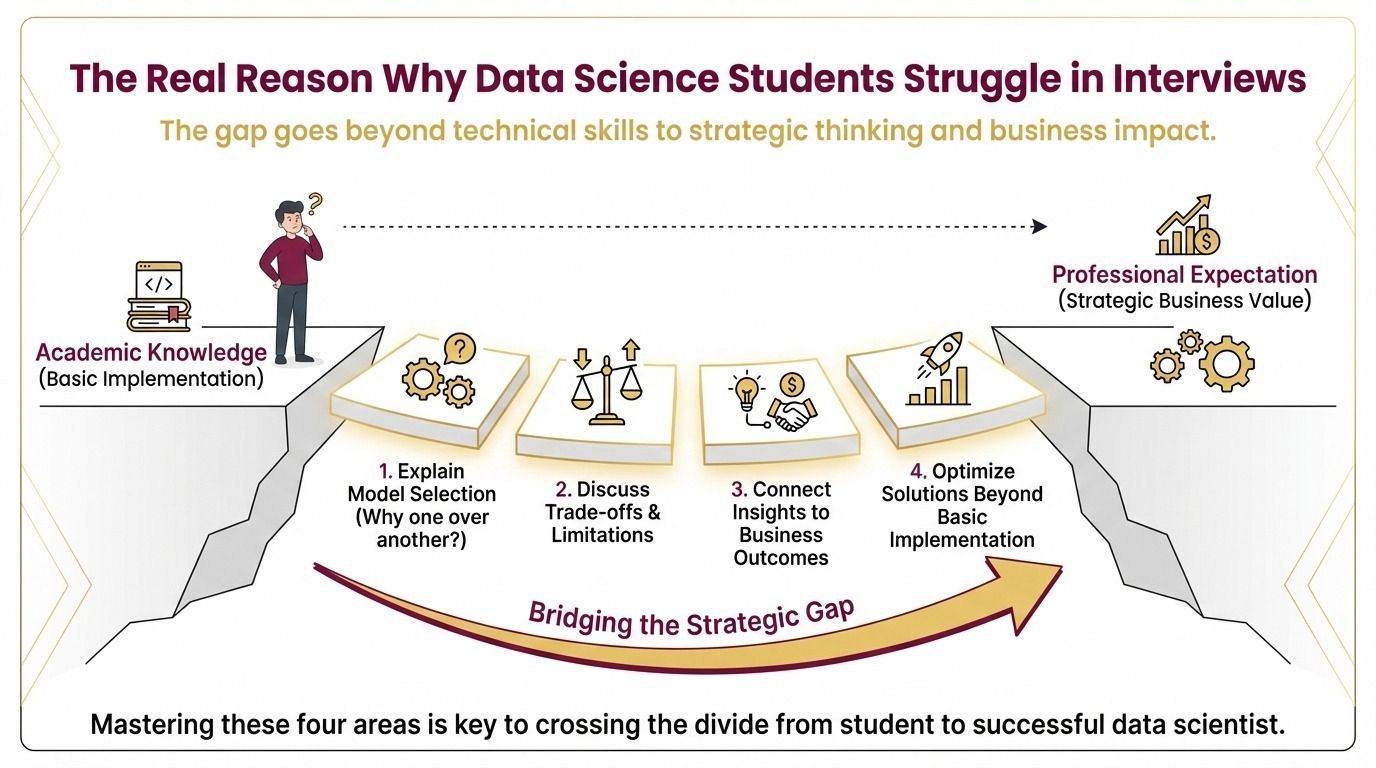
The primary reason why students struggle in data science interviews is the gap between knowledge and execution. Completing a course builds technical familiarity, but interviews measure applied thinking. Recruiters are not testing whether you know definitions; they are evaluating whether you can solve real problems under pressure.
Many students prepare by:
- Watching tutorials
- Practicing predefined questions
- Completing guided projects
- Memorizing common answers
However, interviews introduce ambiguity. Panels ask follow-up questions, challenge assumptions, and test depth. As highlighted in nine reasons, candidates often fail because they cannot clearly demonstrate ownership of their projects or justify their decisions.
The real gap appears when students cannot:
- Explain why one model was chosen over another
- Discuss trade-offs or limitations
- Connect insights to business outcomes
- Optimize solutions beyond basic implementation
Companies hire data scientists to generate measurable value, not just build models. If candidates cannot link technical output to revenue impact, cost reduction, or efficiency gains, interview confidence drops quickly.
This execution gap is the foundation of most interview rejections.
Academic Learning vs Industry-Level Expectations
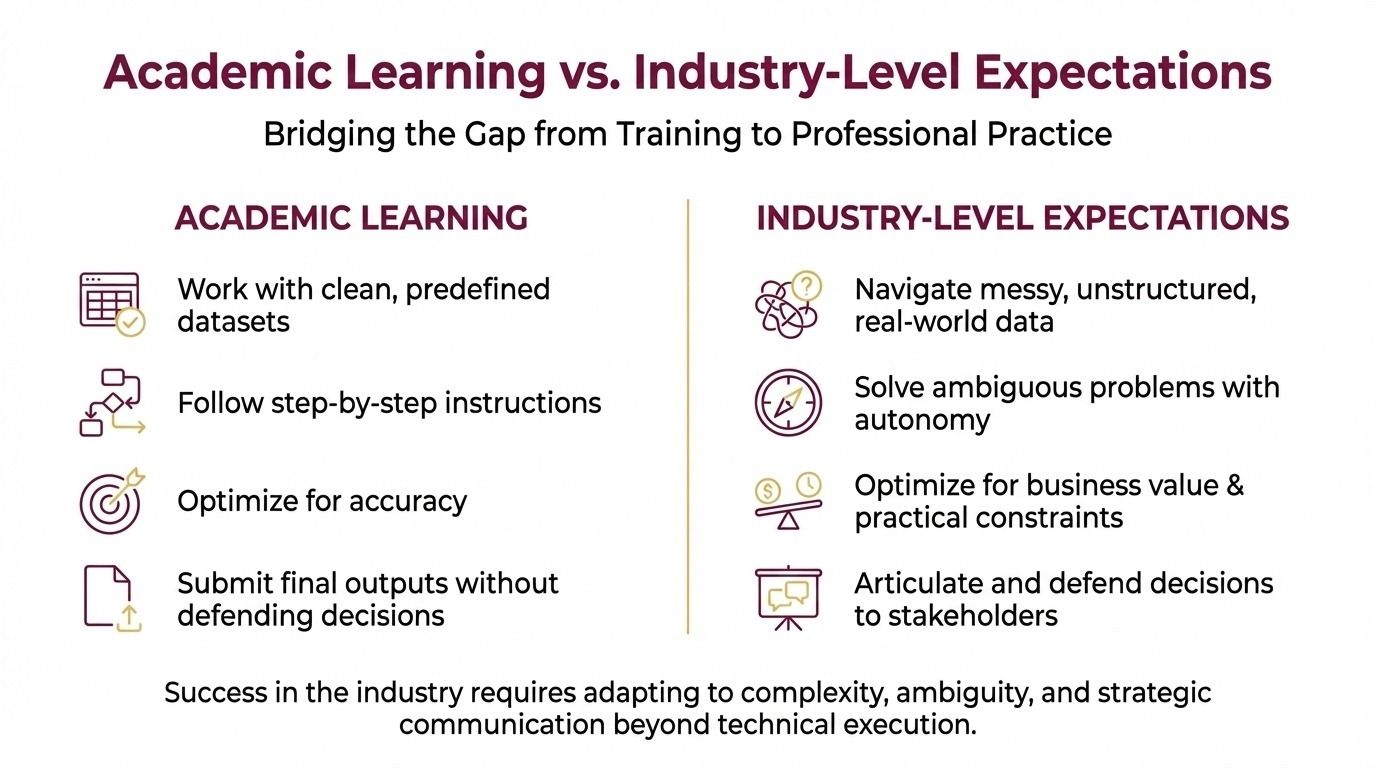
One of the biggest reasons students struggle in interviews is the gap between structured learning and real hiring expectations. Most data science programs are designed for completion, not performance under pressure. Students focus on finishing modules and submitting projects, but interviews evaluate reasoning and clarity.
In training environments, learners typically:
- Work with clean, predefined datasets
- Follow step-by-step instructions
- Optimize for accuracy
- Submit final outputs without defending decisions
Interviews are different. Problems are often ambiguous. Interviewers expect candidates to define assumptions, justify model choices, and explain trade-offs clearly.
This is where many students feel stuck. Without clarity on what skills truly matter, preparation becomes scattered. Reviewing a structured skill-building roadmap helps identify the exact technical and analytical depth companies expect.
Academic systems reward correctness. Industry interviews reward structured thinking, business understanding, and decision ownership.
Unless preparation shifts toward performance-based learning, this gap continues to affect interview outcomes.
What Interview Panels Actually Evaluate Beyond Technical Answers
Many students assume interviews are about solving coding problems correctly. In reality, technical answers are only one part of the evaluation. Accuracy alone does not guarantee selection.
Interview panels are assessing decision-making maturity. They want to understand how you think, not just what you know. A correct solution without clear reasoning often feels risky to recruiters.
During discussions, interviewers typically evaluate
- How do you structure an unstructured problem – Can you break a vague scenario into logical steps?
- Whether you ask clarifying questions – Do you seek missing information before jumping into solutions?
- How logically you justify model selection – Can you explain why one approach is better than alternatives?
- If you can explain trade-offs clearly – Do you understand limitations, risks, and assumptions?
- How you connect results to business metrics – Can you link your solution to revenue, cost, or operational impact?
As highlighted in good bad ugly, interviewers often differentiate candidates based on commercial awareness and reasoning depth, not just coding accuracy.
Strong candidates demonstrate clarity, structure, and value-driven thinking. Interviews are not coding exams; they are evaluations of problem-solving capability in real business contexts.
The Hidden Hiring Signals Students Overlook
Beyond technical correctness, interview panels observe deeper behavioral and cognitive signals. Solving a problem accurately is important but how you arrive at the solution matters even more.
Recruiters pay close attention to subtle indicators such as:
- Confidence under ambiguity – Can you stay calm when the problem is not clearly defined?
- Ownership of project decisions – Do you genuinely understand why you chose a model, or are you repeating steps?
- Clarity in explaining failures – Can you discuss mistakes, limitations, and improvements honestly?
- Ability to simplify complex concepts – Can you explain technical ideas in business-friendly language?
Strong candidates do not just present results. They explain assumptions, defend trade-offs, and connect insights to measurable impact.
If a candidate builds a high-accuracy model but cannot explain how it improves revenue, reduces cost, or increases efficiency, hiring confidence drops immediately. Technical skill without business translation feels risky to recruiters.
Interviews are structured conversations about value creation. Students who prepare only for syntax and coding patterns often miss these deeper evaluation layers, and that is where many promising opportunities are lost.
Costly Interview Mistakes That Reduce Selection Chances
Not all interview failures happen because of weak technical skills. In many cases, candidates lose opportunities due to small but critical execution gaps.
A student may know machine learning well. They may have completed multiple projects. Yet, during interviews, something feels incomplete. Answers sound rehearsed. Explanations lack conviction. Decisions are presented but not defended.
Recruiters interpret this as a risk.
One common issue is over-reliance on memorized responses. When follow-up questions are asked, candidates struggle to adapt. Another mistake is presenting projects without explaining trade-offs or business impact. Strong hiring decisions require confidence that the candidate understands consequences, not just outputs.
Industry observations, such as getting rejected show that repeated rejections often stem from weak applied clarity rather than lack of knowledge.
Here’s how these gaps translate into hiring outcomes:
| Interview Mistake | Recruiter Interpretation | Hiring Impact |
|---|---|---|
| Memorized answers | No depth | Early rejection |
| No project clarity | No ownership | Trust gap |
| Weak SQL reasoning | Execution risk | Technical fail |
| No business explanation | Low ROI thinking | Final round drop |
Hiring managers prioritize reliability. When clarity and reasoning are missing, selection probability drops even for technically capable candidates.
Preparation Approach: Passive Learning vs Strategic Interview Training
Preparation style directly determines interview performance. Many students rely on passive learning, watching tutorials, revising notes, and solving repeated questions. While this creates familiarity, it does not build execution confidence.
Passive preparation often includes:
- Memorizing standard answers
- Practicing predictable datasets
- Revising theory without simulation
- Avoiding real-time explanation drills
This approach feels productive but fails under pressure.
Strategic interview training focuses on execution. It prepares students to think aloud, defend decisions, and handle unexpected follow-up questions confidently.
Here’s how preparation style affects outcomes:
| Preparation Style | Skill Depth | Confidence Level | Interview Outcome |
|---|---|---|---|
| Watching tutorials | Surface | Low | Inconsistent |
| Practicing questions | Moderate | Medium | Improved |
| Real-world simulations | Strong | High | High success probability |
Structured preparation improves not only technical depth but also communication and business reasoning. When students simulate real interview conditions, hesitation reduces and clarity improves.
Preparation is not about learning more. It is about practicing better.
The Structured Path to Improve Interview Success Rate
Interview success rarely improves by chance. It improves when preparation becomes intentional and systematic. Random practice creates random results. Structured preparation creates predictable performance. Many students spend months consuming content but very little time simulating real interview conditions. The turning point happens when preparation shifts from learning concepts to demonstrating competence.
A structured path focuses on building three core layers: depth, clarity, and application.
Depth comes from revisiting projects and understanding every decision made not just what worked, but why it worked. Clarity comes from practicing how to explain models, trade-offs, and limitations in simple language. Application comes from solving ambiguous, case-based problems that mirror real business scenarios.
Effective preparation often includes:
- Practicing detailed portfolio defense
- Participating in mock interview simulations
- Solving open-ended case problems
- Refining communication under timed conditions
- Discussing measurable business impact
Candidates must move beyond “I built this model” to “Here’s why this model was chosen and how it improves outcomes.” Reviewing verified successful placements data further reinforces how structured preparation translates into real hiring success.
When preparation mirrors real evaluation environments, uncertainty decreases. Confidence improves because thinking becomes organized and deliberate.
Interview performance is not accidental. It is the result of disciplined, performance-focused training aligned with industry expectations.
Conclusion
Many students struggle in interviews not because they lack knowledge, but because they are not prepared for how interviews truly work. Technical skills alone are not enough. Recruiters look for structured thinking, clear communication, and the ability to connect solutions to real business impact.
The gap between academic learning and industry expectations often becomes visible during technical rounds. When preparation focuses only on tools instead of reasoning and application, confidence drops under pressure.
With structured, simulation-based preparation, this gap can be closed. Interview success is not about memorizing answers; it is about demonstrating clarity, ownership, and practical thinking.
Take the Structured Path to Interview Success
If you are serious about improving your interview performance, random preparation is not enough. You need structured training that builds technical depth, business reasoning, and real interview confidence.
The PG Certification in AI Powered Data Science is designed to bridge the exact gap discussed in this blog from tool knowledge to execution-ready performance.
Through real-world projects, mock technical panels, and placement-focused preparation, students gain the clarity and confidence needed to perform under pressure.
Interview success is not luck. It is structured preparation.
Start preparing the right way and turn interviews into opportunities, not obstacles.