






Table of Contents
- 1.
- 2.
- 2.1
- 2.2
- 2.3
- 2.4
- 3.
- 3.1
- 3.2
- 4.
- 4.1
- 5.
- 5.1
- 6.
- 7.
- 7.1
- 8.
- 9.
- 10.
- 10.1
- 10.2
- 10.3
- 10.4
- 11.
- 12.
- 13.
- 14.
- 14.1
- 14.2
- 14.3
- 14.4
- 14.5
- 14.6
- 14.7
- 15.
- 16.
- 17.
Introduction: Data Is the New Decision Engine
Every modern business, whether a startup, SME, enterprise, or even a local retail brand is producing massive amounts of data every single day. From customer behavior and marketing performance to operations, finance, and HR metrics, data is everywhere.
Yet, data alone has no value unless it is analysed, interpreted, and converted into actionable insights.
This is exactly why every business needs a data analyst today not as a luxury, but as a necessity.
At the same time, this growing demand has created one of the fastest-growing career opportunities for students and freshers. Companies are no longer asking only for degrees; they are asking for practical data analytics skills.
In this article, we’ll break down:
- Why businesses across industries rely on data analysts
- How data analysts directly impact revenue, growth, and efficiency
- What skills students must start learning right now to become job-ready data analysts
- How structured training and real-world exposure can fast-track careers
Why Every Business Needs a Data Analyst Today
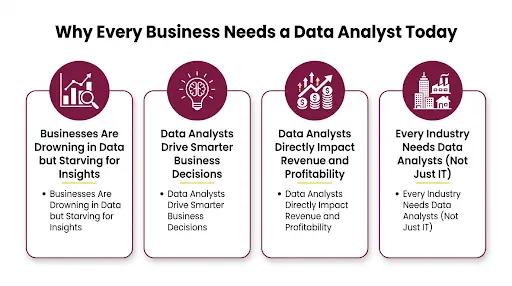
1. Businesses Are Drowning in Data but Starving for Insights
Businesses collect data from:
- Websites and mobile apps
- CRM and ERP systems
- Sales pipelines
- Digital marketing platforms (Google, Meta, LinkedIn)
- Customer support tools
- Finance and accounting software
However, raw data does not answer business questions like:
- Why are sales dropping this quarter?
- Which marketing channel actually brings ROI?
- Why are customers churning?
- Which product features drive repeat usage?
A data analyst bridges this gap by transforming scattered data into clear, decision-ready insights.
2. Data Analysts Drive Smarter Business Decisions
Earlier, decisions were often based on intuition or past experience. Today, competitive businesses rely on data-backed decisions.
A data analyst helps businesses:
- Identify trends and patterns
- Forecast demand and growth
- Reduce risks before they become costly
- Optimize pricing and inventory
- Improve customer experience
📌 According to McKinsey, data-driven organizations are 23 times more likely to acquire customers and 6 times more likely to retain them.
3. Data Analysts Directly Impact Revenue and Profitability
One of the biggest myths is that data analysts only “create reports.” In reality, their work has a direct financial impact.
Examples:
- Identifying underperforming products
- Reducing marketing spend wastage
- Optimizing conversion funnels
- Predicting high-value customers
- Improving supply chain efficiency
For example:
A business spending ₹10 lakhs/month on ads can save 20–30% simply by analyzing campaign performance correctly.
That saving itself justifies the role of a data analyst.
4. Every Industry Needs Data Analysts (Not Just IT)
Data analytics is no longer limited to tech companies.
Today, data analysts are needed in:
- IT & Software
- Digital Marketing
- E-commerce
- Healthcare
- Banking & Finance
- Education
- Manufacturing
- Logistics
- Real Estate
- Government & Public Sector
📌 Gartner reports that over 75% of business decisions will be data-driven by 2026.
This makes data analytics a future-proof skill.
Role of a Data Analyst in Business Growth
A data analyst’s role goes far beyond dashboards.
Key Responsibilities:
- Collecting data from multiple sources
- Cleaning and preparing data
- Analyzing trends and anomalies
- Creating visual reports and dashboards
- Translating data into business recommendations
- Supporting leadership with insights
Real-World Example:
A data analyst may discover:
- Sales drop on weekends in a particular region
- High cart abandonment at a specific checkout step
- Better conversion rates from organic traffic than paid ads
These insights change business strategy, not just reports.
How Data Analysts Help Businesses Compete in an AI-Driven Market
As artificial intelligence, automation, and digital platforms reshape industries, competition is no longer limited to pricing or branding. Today, businesses compete on speed, accuracy, personalization, and intelligence. At the center of all these factors is data analysis.
While AI tools can automate processes, they still rely on clean, structured, and well-interpreted data. This is where the role of a data analyst becomes critical.
Data Analysts as the Bridge Between AI and Business Decisions
AI systems do not operate independently. They depend on:
- Quality historical data
- Correct feature selection
- Business context
- Continuous monitoring and refinement
A data analyst ensures:
- The right data is fed into AI systems
- Outputs are interpreted correctly
- Business leaders understand what the insights actually mean
Without skilled data analysts, many AI implementations fail - not because the technology is weak, but because the data foundation is poor.
According to Harvard Business Review, poor data quality is one of the top reasons AI initiatives fail in organizations.
Data Analytics and Risk Reduction in Business
One of the least discussed but most valuable contributions of a data analyst is risk mitigation.
How Data Analysts Reduce Business Risks:
- Identifying unusual spending patterns
- Detecting early signs of customer churn
- Highlighting declining product performance
- Flagging operational inefficiencies
- Monitoring financial anomalies
For example:
- In finance, analysts help detect fraudulent transactions
- In marketing, they prevent budget overspending
- In operations, they reduce supply chain disruptions
Businesses that use analytics proactively respond faster to threats and avoid costly mistakes.
Why Data Analytics Is a Board-Level Priority Now
Earlier, analytics was seen as a technical or mid-level function. Today, CXOs and founders actively demand analytics dashboards.
Why?
- Decisions must be justified to investors
- Growth strategies need validation
- Market conditions change rapidly
- Customer behavior is unpredictable
Data analysts provide:
- Forecasting models
- Scenario analysis
- Performance benchmarks
- KPI tracking aligned with business goals
📌 This shift is why analytics teams now report directly to senior leadership, not just IT departments.
What Employers Really Look for in a Data Analyst (Beyond Tools)
A common misconception among students is that learning tools alone guarantees a job. In reality, employers evaluate how candidates think, not just what they know.
Key Traits Employers Value:
- Problem-solving mindset
- Ability to ask the right questions
- Logical reasoning
- Business understanding
- Clear communication
For example, two candidates may know Power BI:
- One creates visually appealing dashboards
- The other explains why sales dropped and what should be done next
The second candidate is far more valuable.
This is why contextual learning and real-world exposure are essential in data analytics education.
The Growing Demand for Entry-Level Data Analysts in India
India has emerged as a global analytics hub due to:
- Digital adoption across sectors
- Startup ecosystem growth
- Expansion of e-commerce and fintech
- Government digitization initiatives
📌 According to NASSCOM, India’s analytics and data science market is expected to grow at 25–30% CAGR over the next few years.
This growth has created demand not just for senior professionals, but also for entry-level and junior data analysts who can support analytics teams.
This is a major opportunity for:
- Fresh graduates
- Non-IT background students
- Career switchers
Why Data Analytics Is One of the Safest Careers Against Automation
Ironically, while AI automates many jobs, data analytics remains highly resilient.
Why?
- Analysts interpret data, not just process it
- Business judgment cannot be fully automated
- Human context is essential for decision-making
- Ethics, bias detection, and interpretation need human oversight
📌 The World Economic Forum lists Data Analysts among the top emerging roles globally.
This makes data analytics a long-term, sustainable career choice.
How Students Can Build Trust and Credibility as Data Analysts
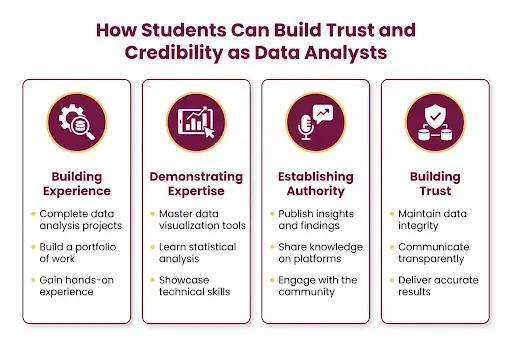
From an EEAT (Experience, Expertise, Authority, Trust) standpoint, students must go beyond certificates.
Building Experience:
- Work on real datasets
- Participate in internships
- Solve practical business problems
- Build project portfolios
Demonstrating Expertise:
- Explain insights clearly
- Justify decisions with data
- Show structured thinking
Establishing Authority:
- Publish case studies
- Create dashboards
- Share insights on LinkedIn or GitHub
Building Trust:
- Ethical data handling
- Accuracy in analysis
- Transparency in assumptions
These elements matter not only to employers, but also to Google AI Search, which increasingly values real-world experience and credibility in content and professionals alike.
The Shift from “Reporting” to “Insight Generation”
Earlier, data analysts were expected to:
- Generate weekly or monthly reports
Today, expectations are higher:
- Provide insights
- Recommend actions
- Predict outcomes
- Measure impact
This evolution has transformed analytics into a strategic function rather than a support role.
Students who understand this shift position themselves ahead of the competition.
Why Learning Data Analytics Now Is a Strategic Career Move
Timing matters in careers.
Learning data analytics now means:
- Entering a high-growth field early
- Gaining experience while demand is rising
- Avoiding saturated job roles
- Staying relevant in an AI-driven economy
Students who delay often struggle to catch up when the market becomes competitive.
Why Businesses Prefer Skilled Data Analysts Over Degrees
One critical shift in hiring is worth noting.
Businesses today prefer:❌ Not just degrees✅ Job-ready skills + real project exposure
Why?
- Tools change rapidly
- Business problems are practical, not theoretical
- Companies want analysts who can work from Day 1
This is why hands-on training, live projects, and internships are becoming more important than academic marks.
What Students Should Learn Now to Become a Data Analyst
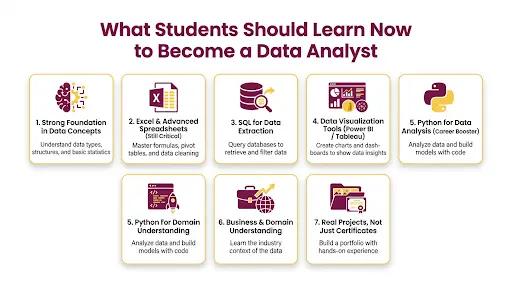
This is the most important section for students, freshers, and career switchers.
1. Strong Foundation in Data Concepts
Before tools, students must understand:
- What is data?
- Types of data (structured vs unstructured)
- Descriptive, diagnostic, predictive analytics
- Business problem framing
Without conceptual clarity, tools become meaningless.
2. Excel & Advanced Spreadsheets (Still Critical)
Despite new tools, Excel remains a core skill.
Students should master:
- Pivot tables
- VLOOKUP / XLOOKUP
- Power Query
- Conditional formatting
- Data cleaning techniques
📌 Most entry-level analyst tasks still start in Excel.
3. SQL for Data Extraction
SQL is non-negotiable for data analysts.
Students must learn:
- SELECT, WHERE, GROUP BY, JOIN
- Subqueries
- Window functions (basic)
- Query optimisation concepts
SQL allows analysts to pull exactly the data they need from databases.
4. Data Visualization Tools (Power BI / Tableau)
Insights are useless if stakeholders can’t understand them.
Students should learn:
- Power BI or Tableau
- Dashboard design principles
- KPI tracking
- Storytelling with data
📌 Clear visuals = faster decisions.
5. Python for Data Analysis (Career Booster)
While not mandatory for beginners, Python adds a huge advantage.
Key libraries:
- Pandas
- NumPy
- Matplotlib / Seaborn
Python enables:
- Automation
- Advanced analysis
- Predictive modeling basics
6. Business & Domain Understanding
Great analysts understand business context, not just numbers.
Students must learn:
- How businesses make money
- Marketing funnels
- Sales pipelines
- Customer lifecycle
- Cost vs revenue metrics
This is what separates average analysts from top performers.
7. Real Projects, Not Just Certificates
Employers ask:
“What have you actually worked on?”
Students should build:
- Sales dashboards
- Marketing analytics reports
- Customer churn analysis
- Financial trend analysis
This is where training institutes like WHY TAP play a critical role.
Why Structured Training Matters More Than Self-Learning
While self-learning is good, many students struggle due to:
- Lack of direction
- No mentorship
- No real datasets
- No interview preparation
- No placement support
A structured program provides:
- Step-by-step roadmap
- Industry-aligned curriculum
- Live projects
- Internship exposure
- Mock interviews
- Placement assistance
WHY TAP: Building Job-Ready Data Analysts, Not Just Learners
At WHY TAP, we focus on employability first.
What Makes WHY TAP Different:
- Industry-oriented curriculum
- Hands-on live projects
- Real business datasets
- Internship & on-the-job exposure
- Career mentoring
- Interview preparation
- Placement support
Our approach is designed to align with what businesses actually need, not outdated academic syllabi.
Career Opportunities After Learning Data Analytics
Students trained in data analytics can pursue roles such as:
- Data Analyst
- Business Analyst
- Marketing Analyst
- Reporting Analyst
- Junior Data Scientist
- Operations Analyst
With experience, roles expand into:
- Senior Analyst
- Analytics Manager
- Data Consultant
- Product Analyst
📌 Data analytics roles consistently rank among top-paying entry-level IT careers in India.
For Students & Freshers
🚀 Want to Become a Job-Ready Data Analyst?Learn industry-relevant data analytics skills with live projects, expert mentorship, and placement support at WHY TAP.👉 Apply Now | Talk to Our Career Advisor
For Career Switchers
🔁 Thinking of Switching to a High-Growth Tech Career?Data Analytics offers one of the fastest transitions from non-IT to IT roles.👉 Join WHY TAP’s Data Analytics Program
Final Thoughts: Data Analysts Are No Longer Optional
To summarise:
- Every business needs a data analyst to survive and scale
- Data analytics drives smarter decisions, efficiency, and growth
- Students who learn the right skills now will stay ahead of the job market
- Practical training and real exposure matter more than theory
The future belongs to those who can interpret data and convert it into action.
If you’re serious about building a career that is relevant, resilient, and rewarding, data analytics is a path worth investing in - and WHY TAP is here to guide you every step of the way.