

Table of Contents
- 1.
- 1.1
- 1.2
- 1.3
- 2.
- 2.1
- 2.2
- 2.3
- 3.
- 4.
- 4.1
- 4.2
- 4.3
- 5.
- 6.
- 6.1
- 6.2
- 6.3
- 6.4
- 6.5
- 6.6
- 7.
The digital marketing landscape is transforming faster in 2025 than in any previous decade. With artificial intelligence (AI) now embedded in almost every marketing tool, students and freshers face a new question:
Should you learn traditional (manual) digital marketing methods or focus on AI-powered marketing tools?
According to recent global reports, 69.1% of marketers use AI in their daily workflow, and the number continues to grow as automation, predictive analytics, and AI-driven personalization become industry standards. This shift has created both opportunities and confusion for students entering the field.
This article breaks down manual vs AI-powered digital marketing, explores the strengths of each, compares their learning value, and helps students choose the right path for long-term career success.
1. What Is Manual Digital Marketing?
Manual digital marketing refers to traditional, human-led marketing activities carried out without automated or AI assistance. This includes writing content, designing creatives, analyzing metrics, building campaigns, segmenting audiences, and optimizing ads manually.
1.1 Key Aspects of Manual Digital Marketing
Hands-On Control
Everything from keyword research to writing ad copy is done manually. Students understand the purpose of each task instead of relying on automated suggestions.
Strong Fundamentals
Manual execution teaches essential elements such as:
- Audience research
- Content strategy
- Search intent
- Ad bidding logic
- Understanding analytics
These fundamentals remain valuable even as tools evolve.
Creativity and Human Touch
Manual work encourages originality:
- Crafting personalized stories
- Writing emotionally resonant content
- Building campaigns that feel authentic
These creative elements cannot be fully replicated by AI.
1.2. Advantages of Manual Digital Marketing
Deep Conceptual Understanding
Students develop real marketing instincts, understand buyer psychology, and know the “why” behind results.
Better for Creative Work
Brand storytelling, copywriting, and emotional content still require human thinking and empathy.
Stronger Skill Foundation
When tools fail or budgets are small, manual execution saves the day. Small businesses often prefer human-led strategies.
1.3 Example of Manual Digital Marketing
A digital marketing student planning a content strategy manually would:
- Research topics
- Analyze search intent
- Write posts
- Schedule content
- Track performance manually
- Review insights and improve
This hands-on experience strengthens practical understanding.
2. What Is AI-Powered Digital Marketing?
AI-powered marketing uses technology, algorithms, and automation tools to ideate, execute, scale, and optimize marketing activities. In 2025, AI is integrated into content writing, SEO, analytics, advertising, customer journey mapping, and personalization.
2.1 Adoption & Impact in 2025
- 88% of marketers globally use AI for daily tasks.
- Businesses using AI report 30–50% faster execution in content, ads, and analytics.
- E-commerce and SaaS companies rely heavily on AI for forecasting and personalization.
The rise of AI has significantly increased productivity and reduced burnout among marketing professionals.
2.2 What AI Can Automate
AI tools can handle or assist with:
- Content generation (blogs, ads, captions)
- Keyword research and clustering
- Campaign optimization
- Audience segmentation
- Predictive analytics
- A/B testing
- Customer journey workflows
- Email automation
- Lead scoring
- Data analysis and reporting
AI dramatically accelerates tasks that would otherwise take hours.
2.3 Example of AI-Powered Digital Marketing
A small e-commerce store could use AI to:
- Generate product descriptions
- Create social media creatives
- Schedule automated posts
- Predict customer purchase patterns
- Send automated offers
- Run retargeting ads
This reduces manual workload and improves efficiency.
3. AI vs Manual Digital Marketing: A Detailed Comparison
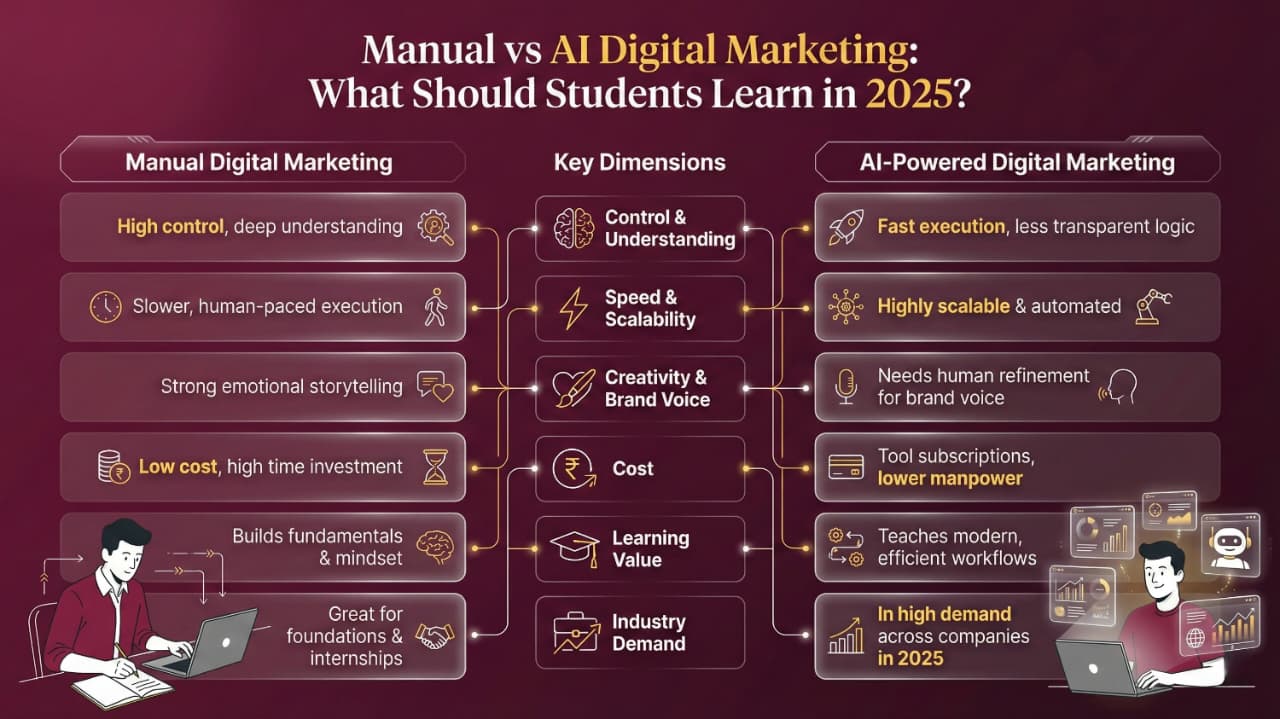
Below is a clear, student-friendly comparison:
| Dimension | Manual Digital Marketing | AI-Powered Digital Marketing |
|---|---|---|
| Control & Understanding | High control; deep understanding of how strategies work | Fast execution, but less visibility into internal logic |
| Control & Understanding | High control; deep understanding of how strategies work | Fast execution, but less visibility into internal logic |
| Speed & Scalability | Slow; limited by human bandwidth | Extremely fast; scales automatically |
| Creativity & Brand Voice | Strong: emotional and authentic | Moderate: AI assists but still needs human refinement |
| Cost | Low cost but time-intensive | May require subscriptions but reduces manpower |
| Learning Value | Teaches core fundamentals and analytical thinking | Teaches modern practices and efficiency |
| Industry Demand | Good for building base skills | Required by most companies in 2025 |
Both approaches have strengths, but the modern marketer needs both.
4. Which Should Students Learn First: AI or Manual?
4.1 Why Learn Manual Marketing First
Build strong foundations
Understanding strategy, psychology, funnels, search intent, and customer behavior helps you use AI tools intelligently.
Better problem-solving
When AI gets it wrong (which happens often), you need manual logic to fix issues.
Higher creativity
Manual learning improves writing, ideation, and critical thinking.
Essential for early-career roles
Most internship tasks include manual work like posting, writing, analyzing small campaigns.
4.2 Why Students Must Learn AI as Well
Companies expect AI skills now
Employers want candidates who know:
- AI-assisted content
- Ad automation
- Data analysis
- ChatGPT workflows
- AI tools for SEO and PPC
- AI multiplies productivity
You can do what normally takes 6 hours in just 1 hour. - Higher salaries for AI-skilled marketers
AI-proficient freshers often earn 30–50% more. - Industry is rapidly shifting
Marketing teams are adopting automation across all levels.
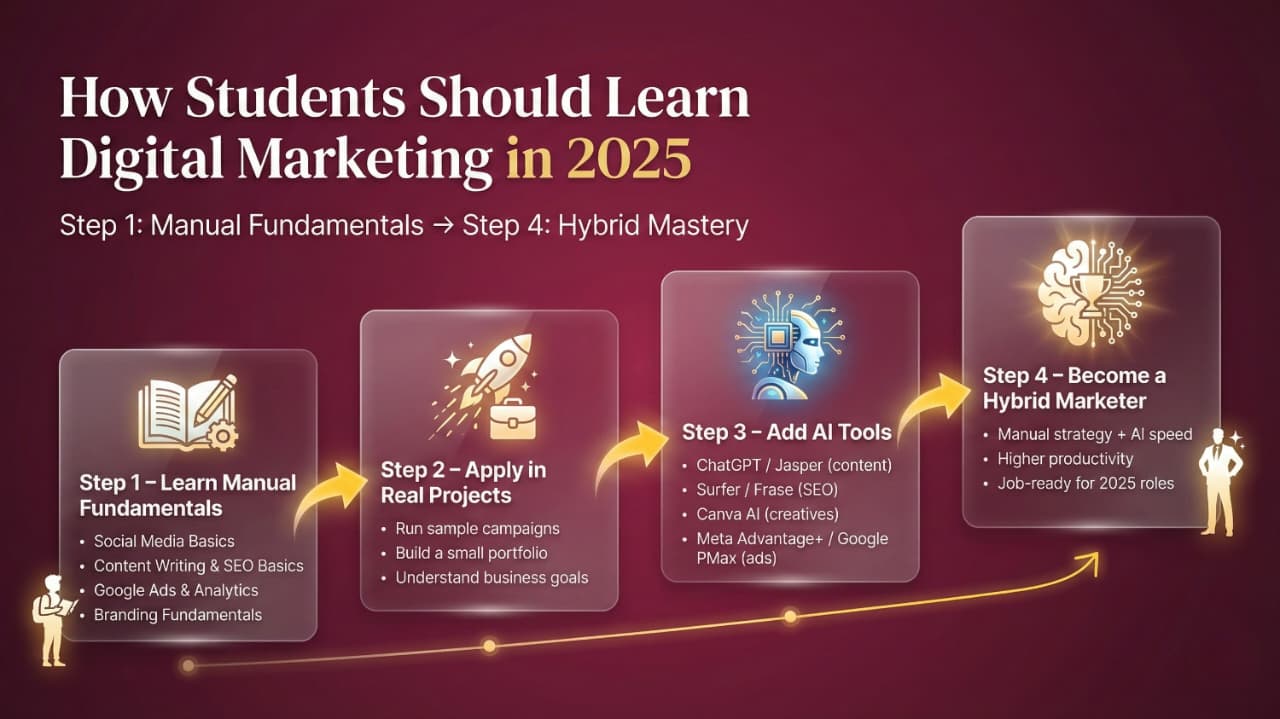
4.3 Recommended Learning Approach (2025)
Step 1: Learn Manual Fundamentals
- Social media
- Content writing
- SEO basics
- Google Ads
- Analytics
- Branding fundamentals
Step 2: Apply Fundamentals in Real Projects
- Work on sample campaigns
- Build your portfolio
- Understand business objectives
Step 3: Start Using AI Tools
- ChatGPT for content and research
- Jasper / Copy.ai for writing
- Surfer / Frase for SEO
- Canva AI for creatives
- HubSpot AI for automation
- Meta Advantage+ AI
- Google PMax
Step 4: Build Hybrid Mastery
Combine manual thinking with AI-powered execution.
This approach gives you the strongest career advantage.
5. Common Myths About Manual vs AI Marketing
Myth 1: AI will replace marketers.
Fact: AI replaces tasks, not people. Strategy still needs human thinking.
Myth 2: Manual marketing is outdated.
Fact: Creativity, brand voice, and storytelling remain human-driven.
Myth 3: AI always produces better results.
Fact: AI improves performance only when paired with strong fundamentals.
Myth 4: Students can skip fundamentals and rely on AI.
Fact: Without foundations, you’ll struggle to fix errors or explain results.
6. What Employers Look for in Digital Marketers in 2025
The digital marketing hiring landscape has changed dramatically in 2025. Companies are no longer looking for candidates who simply know how to post on social media or run basic ads. With AI, automation, and advanced analytics becoming standard across industries, employers now expect talent who can combine strategy, creativity, technical skills, and AI proficiency.
If you want a high-value digital marketing job in 2025, you must understand what hiring managers prioritize. Below is a detailed breakdown.
6.1. Strategic Thinking (The #1 Skill Employers Demand)
Digital marketing today is strategy-driven, not task-driven.
Employers want candidates who can:
- Understand the customer journey
- Identify target audiences
- Build funnels (TOFU–MOFU–BOFU)
- Define KPIs and success metrics
- Apply psychology and persuasion principles
- Create integrated campaigns across channels
Freshers who think strategically stand out instantly because most beginners only focus on tools, not the logic behind them.
Why it matters:
AI can generate content, but it cannot fully design brand strategy. Employers need humans who can interpret insights and make strategic decisions.
6.2. Ability to Execute Manual Campaigns
While AI automation is powerful, companies still rely on marketers who can:
- Write compelling ad copy
- Build landing pages manually
- Perform keyword research
- Optimize campaigns step-by-step
- Create social media posts and content calendars
- Run A/B tests thoughtfully
Manual execution shows that you understand how campaigns work, not just how to use automated shortcuts.
Why it matters:
If AI-generated content or campaigns fail, companies need someone who knows how to fix problems manually.
6.3. AI Tool Productivity (A Mandatory Skill in 2025)
Employers expect candidates to use AI tools to work faster and smarter.
Key tools include:
- ChatGPT / Jasper – content generation & research
- Surfer / Frase – SEO optimization
- Meta Advantage+ AI – automated ad campaigns
- Google Performance Max – AI-driven ads
- HubSpot AI – automation & CRM
- Canva AI – creative generation
Students who know AI-powered workflows deliver results 50–70% faster than those who rely only on manual methods.
Why it matters:
Every company wants higher productivity, lower costs, and quicker execution, AI delivers exactly that.
6.4. Strong Data Analysis Skills (GA4, Meta, Looker, CRM Analytics)
Modern digital marketing is data-first. Employers want marketers who can:
- Read dashboards
- Interpret metrics like ROAS, CAC, CTR, LTV
- Understand attribution
- Identify growth opportunities
- Present insights clearly
Tools you must know include:
- GA4
- Google Tag Manager
- Meta Ads Analytics
- Looker Studio
- HubSpot Analytics
Why it matters:
Data-driven decision-making is crucial for optimizing campaigns and reducing marketing costs.
6.5. Creativity + Analytical Thinking (Hybrid Skillset)
The most valuable digital marketers in 2025 are those who can:
- Write hooks
- Create scroll-stopping content
- Understand audience emotions
- Analyze numbers
- Improve content based on insights
This blend of creativity + analytics is rare and highly paid.
6.6. Adaptability to New Tools & Trends
Marketing evolves monthly, not yearly. Employers want candidates who:
- Learn new tools quickly
- Stay updated with trends
- Experiment with new platforms
- Adapt to AI and algorithm shifts
- Are comfortable with constant changes
Being adaptable makes you future-proof.
Conclusion
AI has transformed digital marketing, making workflows faster, smarter, and more efficient. But manual digital marketing remains essential for building strategy, creativity, and foundational understanding.
For students entering the industry in 2025, the winning formula is clear:
Learn manual fundamentals → Master AI tools → Combine both for maximum impact.
This dual skill set ensures you stay relevant, adaptable, and future-proof in a rapidly evolving digital marketing ecosystem. Those who embrace both approaches will stand out in interviews, earn higher salaries, and accelerate career growth