






Table of Contents
- 1.
- 1.1
- 2.
- 2.1
- 2.2
- 2.3
- 2.4
- 2.5
- 3.
- 4.
- 4.1
- 4.2
- 4.3
- 4.4
- 4.5
- 4.6
- 4.7
- 5.
- 5.1
- 5.2
- 5.3
- 5.4
- 6.
- 7.
India’s digital economy has exploded. From a cafe in Chennai to a tech-startup in Delhi, businesses of all sizes now rely on Google Ads to drive customers, phone-calls and conversions. But the rules of advertising have changed. With AI-powered ad automation, evolving privacy policies, and increasing competition, marketers can no longer depend on old strategies.
Google Ads Updates 2025 in India is smarter, faster and more dynamic than ever. Yet higher efficiency also means higher expectations: you must know where to spend, what to measure, and how to protect your ROI. This article unpacks the Google Ads Updates 2025, current cost benchmarks and ROI-boosting strategies every student, freelancer and business‐owner in India must master.
The evolving landscape: why 2025 matters for Indian advertisers
India’s digital advertising market is growing rapidly; forecasts (industry reports) show strong year-on-year expansion driven by regional adoption, lower mobile data costs and wider smartphone ownership. Google Ads retains a dominant share of intent-driven traffic, but the rules are changing:
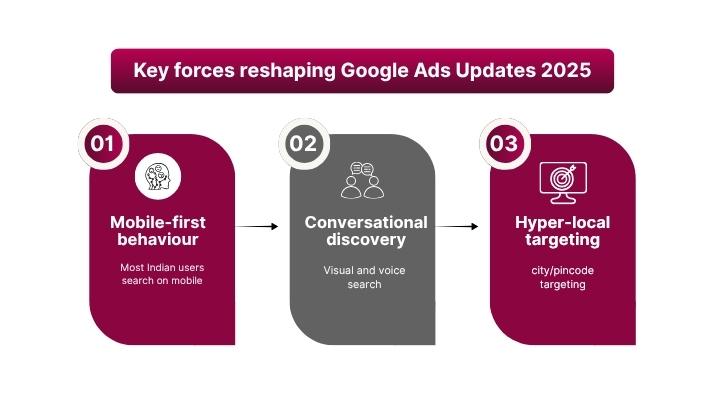
Key forces reshaping Google Ads Updates 2025
- Mobile-first behavior: Most Indian users search on mobile. Ads and landing pages must be mobile-optimized.
- Conversational discovery: Visual and voice search (Google Lens, Assistant, SGE) make search queries more natural language oriented.
- Hyper-local targeting: Regional languages, city/pin code targeting and local inventory features make local creative and inventory optimisation essential.
Practical takeaway: Build campaigns by intent (what users want), device (mobile-first creative), and language (regional headlines), not only by isolated keywords
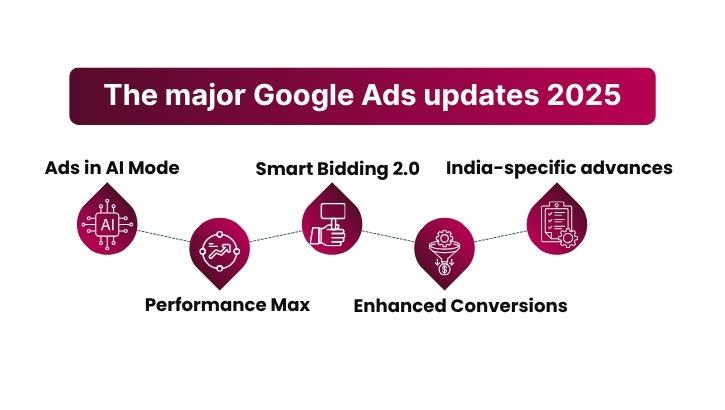
The major Google Ads updates 2025
Google’s announcements in Google Ads Updates 2025 focused on three themes: AI integration, automation control, and measurement resilience The most impactful updates for India:
Ads in AI Mode & Search Generative Experience (SGE)
Search Generative Experience displays AI summaries (answers) with ad placements woven in. Visibility depends on contextual relevance and content quality not just bigger bids.
Action: Align ad copy and landing pages to natural language queries and ensure landing pages are authoritative and fast.
Performance Max (PMax) upgrades
PMax now offers creative controls (select which assets appear where), new objectives (lead gen, store visits), and AI-assisted creative generation (image/video auto-suggestions). It consolidates multi-channel reach Search, YouTube, Gmail, Maps, Display in one campaign type.
Action: Use PMax for omnichannel reach but supply strong, localized assets and monitor placement performance.
Smart Bidding 2.0 & automation enhancements
New bidding models ingest hundreds of signals (device, time, language, location) and respond in real-time to conversion probability shifts (e.g., higher conversions during Chennai evenings).
Action: Use smart bidding but guard with bid caps, seasonality adjustments, and frequent performance checks.
Privacy & measurement: Enhanced Conversions and Consent Mode V2
Enhanced Conversions rely on hashed first-party data to attribute leads securely. Consent Mode V2 helps with compliant measurement under evolving Indian privacy rules.
Action: Prioritize first-party data capture (CRMs, form fills) and implement Enhanced Conversions to improve attribution accuracy.
India-specific advances
- Language indexing for Hindi, Tamil, Telugu improved.
- Local Inventory Ads allow retailers to show product availability nearby.
- Simplified INR billing, monthly invoicing options for MSMEs.
2025 cost benchmarks & budgeting (India)
Costs are still lower than Western markets but rising due to competition and AI bidding.
| Industry | Avg. CPC (₹) | Avg. CPA (₹) | Notes |
|---|---|---|---|
| Education & Training | 25 – 60 | 500 – 1200 | High volume keywords |
| Real Estate | 40 – 90 | 800 – 1500 | Local leads dominate |
| E-Commerce | 20 – 50 | 400 – 800 | Dynamic pricing |
| Healthcare | 30 – 70 | 600 – 1300 | Local search growth |
| Tech Services | 50 – 120 | 900 – 1800 | B2B focus |
Key notes
- CPCs increased ~18% in 2024–25 in many verticals (competitive niches, B2B tech and education).
- Typical SMB monthly budgets range ₹15,000–₹50,000; returns vary with targeting discipline and landing page quality.
Budget optimization tips
- Set campaign-level daily limits and monitor pacing.
- Use Ad Schedule bidding to prioritize high-conversion hours.
- Test regional languages for lower CPC pockets.
- Reinvest incremental spend into top-performing ad groups monthly.
How to maximize ROI from Google Ads Updates 2025 in India
1. Prioritize high-intent keywords
Target keywords that indicate purchase intent (e.g., “digital marketing course with placement Chennai”). Mix Exact and Phrase match and refresh negative keywords weekly.
2. Localize campaigns for language & location
Use Tamil, Hindi, Telugu headlines and local CTAs. Ensure Google Business Profile, location extensions, and accurate NAP details are live localized ads often deliver 15–20% higher CTR and lower CPC.
3.Use full-funnel pairing (Meta + Google)
Top-of-funnel awareness on Meta, intent-stage capture on Google. Retarget Meta engagers with tailored Google search ads to complete the funnel.
4. Use AI insights but don’t over-automate
Enable Auto-Apply Recommendations selectively. Use Google Ads scripts or ARC 360 integrations for automated alerts (CPC spikes, pacing anomalies), but review automated rules weekly.
5. Creative experimentation & A/B testing
Video + interactive creatives beat static text on mobile. Run A/B tests on headlines, CTAs, and landing page variants every two weeks; prioritize mobile-first formats (YouTube Shorts, carousel display).
6. Track the right KPIs
Focus on ROI-driven metrics not vanity metrics. Suggested KPI ranges:
- CTR: 4–7%
- Conversion Rate: 5–10%
- CPL: ₹500–₹900
- ROAS: 4×–6×
7. Leverage first-party data
Import CRM lists for remarketing and custom audiences. WHY TAP’s ARC 360 CRM sync (example) improved lead quality by ~33% in case studies integrate CRM → Google Ads for better targeting.
Challenges, risks & how to mitigate them
Rising competition & CPC inflation
Improve Quality Score with relevant ads, faster landing pages and focused ad groups. Use negative keywords to exclude low-value queries.
Attribution gaps & privacy constraints
Combine Enhanced Conversions, server-side tagging, and UTM/CRM mapping. Consider modeling and data-driven attribution to fill gaps.
Over-automation risks
AI can be wrong for niche businesses. Use automation for scale, but run human audits and conversion checks weekly.
Regional budget disparities
Metros often have 30–40% higher CPCs than tier-2 cities allocate budgets accordingly and experiment in lower-cost geographies.
Actionable checklist (ready to slot into campaigns)
| Area | To-Do | Frequency |
|---|---|---|
| Keyword optimisation | Add negatives & intent phrases | Weekly |
| Campaign structure | Separate Search / Display / YouTube | Setup |
| Localisation | Regional-language assets & extensions | Ongoing |
| Performance review | Audit CTR, CPL, ROAS | Bi-weekly |
| Budget reallocation | Move spend to top ads | Monthly |
| Data integration | Sync CRM → Google Ads | Always |
Conclusion: what marketers should learn in Google Ads updates 2025
Google Ads updates 2025 show the platform moving from manual tactics to AI-first, intent-driven advertising. Marketers who combine creativity, first-party data, and disciplined automation will out-perform competitors. For students and practitioners, mastering AI-powered optimization, performance analytics and localization is essential.