

Table of Contents
- 1.
- 1.1
- 1.2
- 2.
- 2.1
- 2.2
- 3.
- 3.1
- 3.2
- 3.3
- 3.4
- 4.
- 4.1
- 5.
- 6.
- 6.1
- 6.2
- 6.3
- 7.
- 8.
- 9.
- 10.
Digital marketing jobs in India are evolving rapidly due to the rise of AI in digital marketing jobs in India. Global research already confirms this shift. According to McKinsey, AI is expected to significantly improve productivity across knowledge-based roles, including marketing. At the same time, Gartner predicts that AI will influence the majority of marketing decisions by 2026, especially in areas like content creation, personalization, and performance optimization
This transformation is not limited to global markets. India’s digital ecosystem is expanding faster than ever, supported by a growing talent pool and rapid adoption of AI-powered tools. As highlighted in the World Economic Forum’s Future of Jobs Report, roles that combine technology with human judgment will see the strongest growth through 2026.
For students and early professionals, the message is clear: AI is not replacing marketers it’s upgrading them. Those who learn how to work with AI will stay relevant, competitive, and future-ready.
The Current State of Digital Marketing Jobs in India
India’s digital economy is expanding rapidly, and digital marketing plays a central role in that growth. Businesses across industries e-commerce, IT services, ed-tech, healthcare, finance are investing heavily in online customer acquisition and brand building.
Demand for Digital Marketers in India
The demand for digital marketing professionals is no longer limited to metro cities or large enterprises. Today:
- Startups need growth marketers
- SMEs need local and performance marketers
- Global brands need India-focused digital teams
Key market indicators show strong upward momentum:
- India’s digital advertising market continues to grow year-on-year
- Industry estimates suggest over 1.5 million digital marketing roles by 2026
- Entry-level salaries range between ₹3–6 LPA
- Experienced professionals earn ₹15–20 LPA or more, depending on specialization
Real-world example:
A mid-sized e-commerce company in Bengaluru may now hire both an SEO analyst and a performance marketer to scale organic traffic and paid conversions roles that were rare in India just a decade ago.
Skills Employers Expect Today
Employers are no longer hiring based on tool knowledge alone. They look for marketers who understand impact.
Technical skills
- SEO, SEM, and paid advertising
- Analytics and performance tracking
- Content creation across formats
- Familiarity with AI-powered marketing tools
Strategic skills
- Creative storytelling
- Critical thinking and problem-solving
- Clear communication
- Ability to learn and adapt quickly
This shift explains why structured, career-focused learning paths like those offered through WHY TAP are becoming essential for students entering the field.
Why AI Is a Game-Changer for Digital Marketing
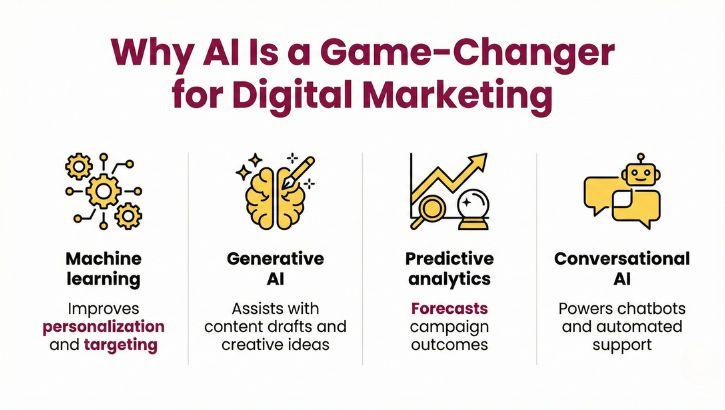
AI is no longer a “next-big-thing” on a slide deck. It’s already embedded in how high-performing digital marketing teams plan, execute, and optimize campaigns. From audience targeting to content delivery, AI is reshaping marketing from a manual, effort-heavy function into a precision-driven growth engine.
In a market like India, where competition is intense and margins are tight, AI gives marketers a serious edge. It enables faster decision-making, reduces human error, and unlocks insights that were previously invisible. In short: AI doesn’t replace marketing strategy; it amplifies it.
What AI Actually Means in Digital Marketing
AI in digital marketing refers to intelligent systems that analyze large datasets, predict outcomes, and automate repetitive tasks. Instead of manually adjusting bids or researching keywords, marketers now use AI to generate insights instantly.
Example: An SEO executive who previously spent hours on keyword research can now use AI tools to cluster keywords, analyze search intent, and identify content gaps within minutes.
According to Gartner, AI will influence the majority of marketing decisions by 2026, especially in content, personalization, and performance optimization.
Key AI Technologies Impacting Marketing
Several AI technologies are already reshaping how marketers work:
- Machine Learning: Improves targeting and personalization
- Generative AI: Assists with content drafts and creative ideas
- Predictive Analytics: Forecasts campaign outcomes and trends
- Conversational AI: Powers chatbots and automated customer support
Real-life example:
An e-commerce brand uses AI to analyze customer behavior and automatically reallocate ad budgets improving ROI without increasing manual workload.
How AI Will Transform Digital Marketing Jobs by 2026
AI is not eliminating digital marketing roles; it is redefining them. By 2026, most roles will move away from manual execution toward strategy, creativity, and analysis.
SEO Jobs Will Shift From Manual Work to Strategy
AI now handles keyword clustering, technical audits, and content briefs. Human marketers focus on direction and intent.
Human-led SEO responsibilities include:
- Search intent mapping
- Topical authority building
- EEAT-driven content strategy
Instead of managing spreadsheets, SEO professionals decide:
- What content to create
- Why it matters
- Who it serves
Content Marketing Will Become AI-Assisted, Not AI-Replaced
AI helps with ideas, outlines, and drafts. Humans own trust and storytelling.
Humans control
- Brand voice
- Emotional depth
- Credibility and experience
Google’s guidance on helpful content clearly prioritizes experience and expertise over automation
Paid Ads & Performance Marketing Will Become Data-Led
AI-driven bidding and targeting are already standard on ad platforms.
Marketers now focus on:
- Creative strategy
- Funnel optimization
- ROI and attribution
Google highlights how AI improves campaign efficiency across advertising workflows
Social Media Roles Will Focus on Creativity & Community
AI dashboards replace manual reporting, but creativity cannot be automated.
Successful social media marketers will stand out by:
- Understanding trends
- Building communities
- Creating culturally relevant content
Automation supports the work; it doesn’t replace the human connection.
Digital Marketing Roles That Will Grow (Not Disappear)
AI creates higher-value roles rather than eliminating jobs. According to the World Economic Forum, roles combining technology with human judgment will grow fastest
High-growth roles include
- AI-powered SEO strategist
- Performance marketing analyst
- Content & brand strategist
- Marketing automation specialist
- Data-driven growth marketer
McKinsey reports that companies using AI with skilled human oversight see 20–30% productivity gains
High-Growth Digital Marketing Roles
The roles seeing the strongest demand include:
- AI-powered SEO Strategist – Focuses on search intent, topical authority, and content direction while AI handles audits and data
- Performance Marketing Analyst – Uses AI-driven insights to optimize funnels, ROI, and attribution, not just ad spends
- Content & Brand Strategist – Owns storytelling, trust-building, and brand voice, supported by AI-assisted content workflows
- Marketing Automation Specialist – Designs AI-led customer journeys using email, CRM, and personalization tools
- Data-driven Growth Marketer – Turns AI insights into scalable growth strategies across channels
Roles Losing Relevance or Undergoing Major Change
1. Pure Data Entry Roles
Manual data entry is rapidly disappearing. Automated tools now collect, sync, and clean data faster and with fewer errors. Employers no longer need people to enter numbers; they need professionals who can validate data, spot patterns, and extract insights.
2. Manual SEO Submission Jobs
Bulk directory submissions and manual link building are no longer effective. Search engines now reward content quality, relevance, and user intent. Automation has reduced low-value SEO tasks, shifting the role toward strategy, content optimization, and authority building.
3. Repetitive Reporting Roles
Static reports and delayed spreadsheets are being replaced by real-time dashboards and live analytics. Decision-makers want instant visibility and clear recommendations, not weekly reports. According to Gartner, most reporting workflows are expected to be automated by 2026.
Skills Students Must Learn to Survive & Grow in the AI Era
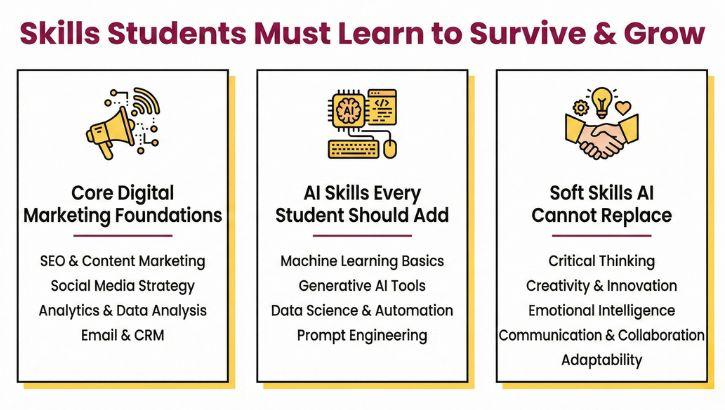
AI is changing how digital marketing jobs work and raising expectations for freshers. Just knowing tools is no longer enough. Companies now look for people who understand the basics and can think clearly about results.
To build a strong career, students need a mix of core digital marketing knowledge, basic AI skills, and human abilities like thinking and communication. This mix helps them learn faster, adapt to change, and perform better at work.
In today’s world, the goal is not to compete with AI.
The goal is to use AI smartly while adding human thinking and creativity.
Core Digital Marketing Foundations (Must-Have Skills)
These are the building blocks of any digital marketing career. AI supports them but cannot replace them.
- SEO fundamentals (search intent, on-page basics, content structure)
- Social media basics (platform behavior, content formats, engagement)
- Paid ads and analytics concepts (funnels, conversions, ROI)
Marketing and analytics skills are evolving rapidly, making strong fundamentals more important than ever.
AI Skills Every Student Should Add
AI doesn’t remove jobs it raises the skill level required.
Students should learn:
- Prompt writing for marketing tasks
- AI-based content optimization and ideation
- Data interpretation and insight extraction
- Basics of marketing automation and workflows
AI literacy helps students work faster, make better decisions, and deliver higher value from day one.
Soft Skills AI Cannot Replace
These skills ensure long-term relevance, regardless of how technology evolves.
- Critical thinking and logical decision-making
- Creativity and original thinking
- Clear communication
- Strong business understanding
AI can assist with execution, but humans drive strategy, judgment, and impact.
How Students in India Can Prepare Step-by-Step
Let’s cut the fluff. AI isn’t killing digital marketing jobs in India unprepared students are. If you want to stay relevant, visible, and employable, this is the real roadmap.
Step 1 – Master the Basics (This Is Your Power Move)
Before touching any AI tool, learn marketing like a pro.
Why?
Because AI doesn’t create strategy it scales your thinking.
Lock in:
- Customer psychology (why people click, buy, ignore)
- Content, SEO, social media, and ads
- Core metrics: CTR, CPA, ROAS, conversions
Hard truth: Weak fundamentals + AI = faster failure.
Step 2 – Use AI Smartly (Don’t Let It Use You)
AI should work with you, not instead of you.
Use AI to:
- Generate ideas faster
- Analyze data patterns
- Improve content structure
But always:
- Verify facts
- Add human judgment
- Customize for Indian audiences
Winning mindset: AI is your intern. You’re the strategist.
Step 3 – Build Proof, Not Just Profiles
Certificates look nice. Projects close interviews.
What actually impresses recruiters:
- Blogs that rank
- Ads with real results
- Social media growth experiments
- Analytics reports
- Internships & freelance work
Corporate reality: One real project beats ten online courses.
Step 4 – Stay Updated or Stay Invisible
Digital marketing changes every week.
If you’re not learning, you’re lagging.
Do this regularly:
- Follow trusted industry blogs
- Track AI updates in marketing tools
- Study real brand campaigns
Career truth: Updated marketers get hired. Outdated ones get ignored.
What Employers Will Look for in 2026
By 2026, hiring decisions will be faster, stricter, and outcome-driven. Employers won’t evaluate potential they’ll evaluate performance signals.
This is what actually sits on the hiring checklist.
1. AI Fluency in Daily Work (Not Tool Collecting)
Employers don’t care how many AI tools you know.
They care how naturally AI fits into your workflow.
They will assess:
- How you use AI to speed up research and execution
- Whether your prompts show business thinking
- If AI output improves quality, not noise
Hiring lens: “Does this person get better results with AI?”
2. Decision Ownership Using Data
Managers want people who own outcomes, not excuses.
They’ll look for:
- Clear reasoning behind every decision
- Ability to read performance numbers and adjust fast
- Comfort explaining failures using data
Employer mindset: If you can’t explain numbers, you can’t scale responsibility.
3. Evidence of Execution (Not Learning History)
Recruiters scan for signals of action, not education timelines.
What stands out:
- Projects launched, not planned
- Experiments run, not ideas discussed
- Results documented, even if small
Truth: Hiring teams trust builders more than learners.
4. Adaptability Under Change
2026 roles won’t be stable tools, platforms, and rules will shift.
Employers value:
- Speed of learning over perfection
- Comfort with change
- Curiosity under pressure
Strategic reality: Adaptability is the new experience.
Future Outlook – Digital Marketing Careers in India Beyond 2026
AI will change execution, not opportunity
The future of digital marketing in India looks stronger, not smaller. AI will automate routine execution, but it will increase demand for professionals who think strategically and make data-backed decisions.
India’s advantage lies in its large talent pool, cost-efficient expertise, and rapid digital adoption. These factors make Indian marketers highly valuable for both local and global brands.
As AI takes over repetitive tasks, roles will shift toward strategy, performance analysis, brand growth, and leadership. Students who adapt early, build real skills, and learn continuously will move into leadership roles faster and stay ahead beyond 2026.
Final Thoughts
AI is not replacing digital marketers in India it is changing how marketing work gets done. While routine tasks are becoming automated, skills like strategy, creativity, data interpretation, and decision-making are gaining more value.
For students, this shift is a clear opportunity. Those who build strong fundamentals and learn to work effectively with AI will stay relevant and in demand. Digital marketing careers beyond 2026 will belong to professionals who can balance technology with human insight.
Strong fundamentals + smart use of AI + continuous learning will define long-term career success.
Ready to build a future-ready career?
Join AI-powered digital marketing and learn how modern marketers combine strategy, creativity, data, and AI to drive real results.
Get started with practical, industry-aligned learning designed for today’s job market.
Explore programs at WHY TAP
Start learning today. Stay relevant tomorrow.