

Table of Contents
- 1.
- 2.
- 2.1
- 2.2
- 3.
- 4.
- 4.1
- 5.
- 5.1
- 6.
- 7.
- 7.1
- 8.
- 9.
- 10.
- 11.
- 11.1
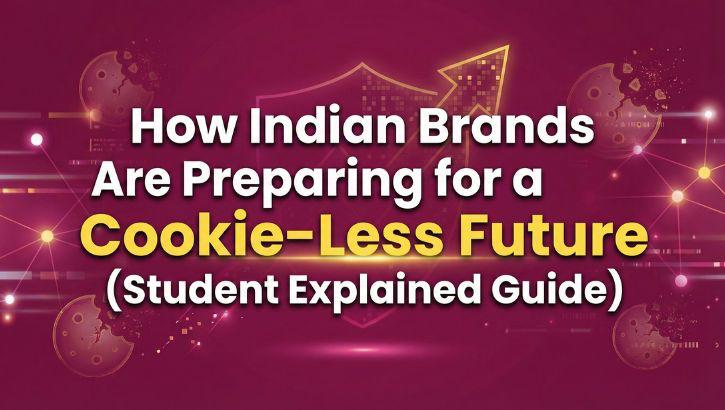
Cookie-Less Future in Digital Marketing
Digital marketing is changing fast, and one of the biggest shifts is the move toward a cookie-less future in digital marketing. With browsers phasing out third-party cookies and users becoming more privacy-conscious, brands can no longer rely on traditional tracking methods to understand audiences and run ads effectively.
Industry reports show that a large share of digital advertising depended on third-party cookies, making this shift a serious challenge for businesses. At the same time, it opens up new opportunities through first-party data, privacy-first strategies, and AI-driven marketing.
The good news is that marketing isn’t stopping it’s evolving. In the sections below, we’ll briefly explain what a cookie-less future means, how brands are adapting, and what students should learn to stay relevant in this new digital landscape.
What Is a Cookie-Less Future in Digital Marketing?
The cookie-less future refers to a shift where third-party cookies are no longer used to track users across websites. Instead of relying on hidden tracking, brands must adopt privacy-first, transparent ways to understand audiences and measure performance.
What Are Third-Party Cookies (In Simple Terms)?
Third-party cookies are small files placed by domains other than the website you’re visiting. They were mainly used for ad targeting and tracking.
- Track users across multiple websites
- Build interest-based advertising profiles
- Power retargeting ads (seeing the same ad everywhere)
- Enable cross-site attribution and measurement
Why they’re going away:
- Users want more control over personal data
- Browsers are blocking or limiting third-party cookies
- Regulations demand consent and transparency.
What “Cookie-Less” Actually Means for Brands
A cookie-less future does not mean “no data.” It means different, better data practices.
- Shift from third-party data to first-party data
- Use data users willingly share (email, sign-ups, purchases)
- Focus on contextual targeting instead of behavior tracking
- Rely on aggregated and modeled insights, not individual tracking
- Build trust through consent-based marketing
What changes for marketers:
- Less dependence on invasive tracking
- More emphasis on content, context, and value
- Stronger role for analytics, AI, and customer experience
In short, the cookie-less future pushes digital marketing toward ethical, sustainable, and user-trusted strategies – and brands that adapt early gain a long-term advantage.
Why Cookies Are Being Phased Out in India
The phase-out of third-party cookies is being driven by a mix of user expectations, platform decisions, and regulatory pressure. For Indian brands, this change is no longer theoretical—it’s an immediate reality that impacts how digital marketing works.
Here’s why cookies are being phased out:
Rising awareness around user privacy
- Users are more conscious about how their data is collected and used
- Concerns around tracking without consent are growing rapidly
- People expect transparency and control over their personal information
Browser and platform-level changes
- Major browsers are restricting or eliminating third-party cookies
- Platforms are redesigning ad systems to align with privacy-first standards
- Cookie-based tracking is becoming unreliable and inconsistent
Regulatory and compliance pressure
- Data protection frameworks emphasize consent and data minimization
- Brands are expected to justify how and why user data is collected
- Non-compliance risks include loss of trust and legal consequences
India can’t stay “cookie-complacent” anymore
- Indian marketers historically relied heavily on third-party cookies
- Global platforms are forcing a shift regardless of market readiness
- As highlighted in Time for India to snap out of cookie complacency, brands must adopt new technologies and strategies instead of delaying change
What this means for marketers:
- Old targeting and attribution methods won’t work the same way
- Brands must rethink data, trust, and customer relationships
- Early adopters of privacy-first approaches gain a competitive edge
The cookie phase-out isn’t a setback; it’s a reset toward more responsible digital marketing.
How the Cookie-Less Shift Impacts Indian Brands
The move toward a cookie-less future is forcing Indian brands to rethink how they target, track, and engage users. Strategies that once depended heavily on third-party cookies are no longer reliable, pushing brands to adopt smarter, privacy-first approaches.
Here’s how this shift is impacting brands:
Reduced effectiveness of traditional ad targeting
- Third-party audience tracking is becoming limited
- Retargeting ads are less precise than before
- Brands can no longer “follow users” across websites.
Changes in measurement and attribution
- Cookie-based attribution models are losing accuracy
- Brands must rely on aggregated, modeled, or contextual data
- Performance measurement now focuses more on trends than individuals
Greater focus on trust and transparency
- Users expect clear consent and ethical data usage
- Brands that respect privacy build stronger long-term relationships
- Trust is becoming a competitive advantage
Shift toward AI and predictive technologies
- AI helps analyze behavior without invasive tracking
- Predictive models replace cookie-based personalization
- Data quality matters more than data quantity
As explained in Artificial Intelligence (AI) adoption in marketing strategies, This paper examines the transformative impact of Artificial Intelligence (AI) on marketing, focusing on its role in enhancing customer engagement, decision-making, and operational efficiency.
Marketing Before vs After the Cookie-Less Shift
| Area | With Third-party Cookies | Cookie-Less Future |
|---|---|---|
| Targeting | Cross-site tracking | Contextual & first-party data |
| Personalization | Behavior-based | AI & predictive insights |
| Measurement | Cookie-based attribution | Modeled & aggregated data |
| User Trust | Low transparency | Privacy-first & consent-driven |
The cookie-less shift is not limiting marketing; it’s reshaping it into a more ethical, data-smart, and future-ready model.
How Indian Brands Are Preparing for a Cookie-Less Future
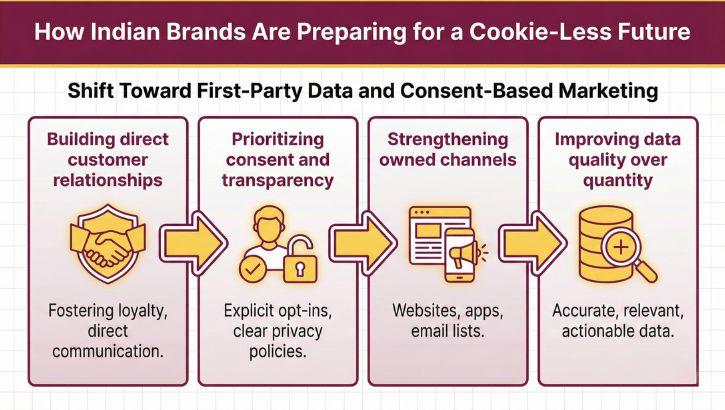
Indian brands are actively adapting their digital strategies to stay effective without relying on third-party cookies. Instead of depending on invasive tracking, they are focusing on owned data, trust, and smarter technology to understand and engage customers.
Shift Toward First-Party Data and Consent-Based Marketing
One of the biggest changes is the move toward first-party data – Cdata collected directly from customers with clear consent.
Key approaches brands are adopting:
Building direct customer relationships
- Collecting data through website sign-ups, newsletters, apps, and loyalty programs
- Using CRM systems to manage and analyze customer interactions
Prioritizing consent and transparency
- Clearly explaining how data is collected and used
- Giving users control over preferences and permissions
Strengthening owned channels
- Email marketing, mobile apps, and community platforms
- Reduced dependence on third-party ad networks
Improving data quality over quantity
- Focusing on accurate, relevant data rather than large anonymous datasets
- Better segmentation and personalization using trusted data sources
As explained in Going cookie less: how brands are converting, brands that invest in consent-based data strategies see stronger engagement and higher conversion rates, even without third-party cookies.
By shifting to first-party data and ethical practices, Indian brands are not just complying with privacy expectations they’re building long-term customer trust and sustainable growth in a cookie-less future.
Role of AI and Predictive Analytics in Cookie-Less Marketing
As third-party cookies fade away, AI and predictive analytics are becoming the backbone of modern digital marketing. Instead of tracking individuals across websites, brands now rely on intelligent systems to understand patterns, predict behavior, and make data-driven decisions while respecting user privacy.
Here’s how AI is helping brands operate in a cookie-less world:
Predicting user behavior without invasive tracking
- AI analyzes aggregated and anonymized data to identify trends
- Brands can predict interests, intent, and engagement without tracking individuals
- This ensures personalization without violating privacy expectations
Contextual targeting replacing behavioral tracking
- AI helps place ads based on content relevance, not user history
- Campaigns are aligned with what users are viewing in the moment
- This improves ad relevance while staying privacy-compliant
Smarter measurement and attribution
- Predictive models estimate performance where direct tracking is unavailable
- AI-powered analytics focus on patterns, cohorts, and outcomes
- Marketers shift from exact attribution to modeled insights
Improved decision-making for brands
- AI processes large data sets faster than manual analysis
- Marketers get actionable insights instead of raw data
- Campaigns are optimized continuously using machine learning
According to Adobe’s research on cookie less readiness in India, organizations that adopt AI-driven analytics are better prepared to maintain performance and customer trust in a privacy-first ecosystem.
In a cookie-less future, AI doesn’t replace marketers – it empowers them to market smarter, ethically, and at scale.
What the Cookie-Less Future Means for Digital Marketing Careers
The shift to a cookie-less ecosystem isn’t just changing tools it’s reshaping digital marketing career paths. As tracking becomes privacy-first, employers are looking for marketers who understand data ethics, AI-led insights, and customer-centric strategies.
New Skills Marketers Must Learn in a Privacy-First World
To stay relevant, marketers need to move beyond cookie-dependent tactics and build modern capabilities.
Key skills in demand include:
First-party data strategy
- Collecting, organizing, and activating data from owned channels (web, apps, CRM)
Analytics & measurement without cookies
- Working with modeled attribution, cohorts, and aggregated insights
AI-powered marketing tools
- Using predictive analytics for targeting, personalization, and optimization
Consent-based and ethical marketing
- Designing journeys that respect privacy and build trust
Customer experience thinking
- Focusing on long-term value instead of short-term tracking hacks
Career impact for students:
- Higher demand for data-aware, privacy-ready marketers
- Faster growth for professionals who adapt early
- New roles in analytics, growth, CRM, and AI-led performance
As discussed in The scope of digital marketing in 2025, marketers who combine strategy, data, and ethics are better positioned for sustainable growth. In a cookie-less future, careers won’t be built on tracking tricks but on trust, insight, and intelligence.
Skills Students Must Learn to Stay Relevant in a Cookie-Less World
As digital marketing moves toward a cookie-less future, students need to upgrade their skill sets to match how brands actually operate today. Learning outdated, cookie-dependent tactics is no longer enough. What matters now is understanding privacy-first, data-smart marketing.
Here are the key skills students should focus on:
First-party data fundamentals
- Understanding how brands collect data through websites, apps, emails, and CRM
- Learning how consent-based data works
- Using data responsibly to personalize experiences
Analytics without third-party cookies
- Reading reports based on aggregated and modeled data
- Understanding trends, cohorts, and performance patterns
- Making decisions without relying on individual user tracking
AI-powered marketing tools
- Using AI for audience insights, content optimization, and prediction
- Understanding how AI supports targeting in a privacy-first environment
- Interpreting AI outputs instead of blindly following them
Customer journey and experience thinking
- Mapping user journeys across owned platforms
- Focusing on long-term engagement rather than short-term clicks
- Aligning content, ads, and communication with user intent
Continuous learning and certification
- Cookie-less marketing is evolving fast
- Structured certifications help students stay updated with industry changes
To understand which learning paths matter most, explore High-paying digital marketing certifications. These certifications reflect the skills employers value in a privacy-first digital ecosystem.
For students, adapting early means staying relevant, confident, and future-ready in a cookie-less marketing world.
Why Learning Privacy-First & AI-Powered Marketing Early Matters
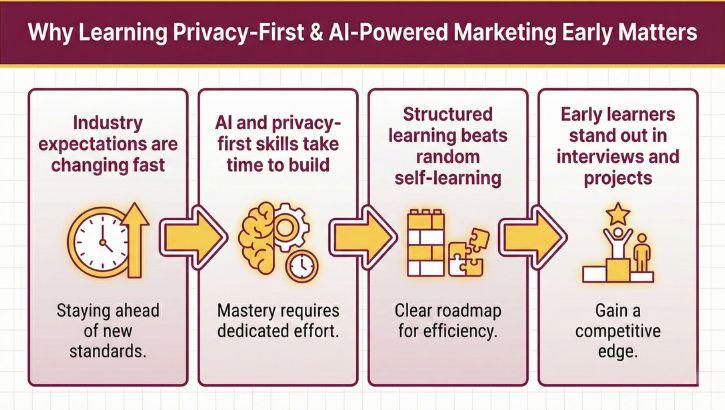
The cookie-less shift is not a future problem – it’s already happening. Students who start learning privacy-first and AI-powered marketing early gain a clear advantage over those who wait until these changes become mandatory in the workplace.
Here’s why early learning matters:
Industry expectations are changing fast
- Brands are actively moving away from cookie-based strategies
- Entry-level roles now expect awareness of first-party data and privacy norms
- Students without this knowledge risk learning outdated practices
AI and privacy-first skills take time to build
- Understanding AI-driven insights and modeled analytics isn’t instant
- Early exposure helps students think strategically, not mechanically
- Confidence grows through practice, not last-minute learning
Structured learning beats random self-learning
- Cookie-less marketing involves tools, data ethics, and strategy together
- Guided training helps students understand why a method works, not just how
- This reduces confusion and builds job-ready clarity
Early learners stand out in interviews and projects
- Students can confidently talk about privacy-first campaigns
- Projects reflect modern marketing approaches, not outdated tactics
- Recruiters value candidates who understand where the industry is heading
Expert Perspectives on India’s Cookie-Less Transition
As the cookie-less future becomes a reality, industry experts agree on one thing: this shift is not the end of digital marketing, but the beginning of smarter and more ethical practices. Leaders across marketing, technology, and data privacy emphasize that brands which adapt early will gain long-term advantages.
Here’s what experts are highlighting about India’s transition:
Privacy-first is no longer optional
- Experts stress that consumer trust is now a key growth driver
- Brands that respect user data are more likely to retain customers
- Transparency and consent are becoming standard expectations
First-party data will define competitive advantage
- Industry leaders recommend investing in owned channels like websites, apps, and CRM
- Direct customer relationships reduce dependency on external platforms
- Quality of data matters more than volume
AI will replace cookie-based assumptions
- Experts see AI and predictive analytics as essential for decision-making
- AI helps brands understand intent without violating privacy
- Data modeling and contextual intelligence are shaping future strategies
Talent must evolve with the ecosystem
- Professionals need to understand data ethics, analytics, and AI tools
- Continuous learning is critical in a privacy-first environment
Insights and leadership views shared on WHY TAP CEO Writes reflect how forward-thinking organizations are preparing for this transition and guiding talent to adapt confidently.
Brands and professionals who embrace the cookie-less shift early will lead the next phase of digital marketing in India.
Final Thoughts
The move toward a cookie-less future in digital marketing is changing how brands collect data, run campaigns, and build customer relationships. While third-party cookies are fading, opportunities are growing through first-party data, AI-driven insights, and privacy-first strategies.
Indian brands that adapt early are already focusing on trust, transparency, and smarter technology rather than outdated tracking methods. For students and aspiring marketers, this shift is not something to fear it’s a chance to build future-ready skills that the industry actually needs.
Cookie-less marketing isn’t about losing data; it’s about using data more responsibly and intelligently. Those who understand this transition today will be better prepared for tomorrow’s digital marketing roles.
Build Future-Ready Digital Marketing Skills with WHY TAP
At WHY TAP, we help students and professionals stay ahead of real industry changes like the cookie-less shift. Through practical, AI-powered and privacy-first digital marketing training, expert mentorship, and career-focused learning, you gain the confidence to adapt, perform, and grow in a changing digital landscape.
Explore our PG Certification in AI-Powered Digital Marketing and start building skills that align with how brands are marketing today – not how they marketed yesterday.