

Table of Contents
- 1.
- 2.
- 3.
- 4.
- 5.
- 6.
- 6.1
- 7.
- 7.1
- 8.
- 9.
- 10.
- 11.
- 11.1
AI Tools for Marketing and Tech Students
AI is rapidly changing how students learn, work, and get hired. For many learners, AI tools for marketing and tech students still feel complex or out of reach, especially without real-world experience. However, companies across marketing and technology are already using AI daily to improve productivity, decision-making, and performance.
Industry studies show that a large majority of marketers now rely on AI-powered tools, and tech teams increasingly use AI to speed up coding, testing, and automation. This creates a clear problem: students who don’t understand or use AI tools risk falling behind in an AI-driven job market.
The good news is that AI tools are more accessible than ever. With the right approach, students can start using them early to learn faster and build in demand skills. In the sections below, we’ve discussed these AI tools in detail, how they are used, and why they matter for marketing and tech careers in 2026.
Why AI Tools Are No Longer Optional for Students
AI tools have moved from being a “nice-to-have” skill to a basic expectation across marketing and technology roles. What was once limited to large companies or advanced teams is now used daily by startups, agencies, and enterprises alike. For students preparing for future careers, ignoring AI is no longer an option.
Here’s why AI tools are becoming unavoidable:
● AI adoption is accelerating across industries
○ Marketing teams use AI for content creation, ad optimization, personalization, and analytics
○ Tech teams rely on AI for coding assistance, automation, testing, and debugging
○ According to AI marketing statistics and industry adoption, a significant percentage of businesses already use AI-driven tools to improve efficiency and results
○ This trend continues to grow year over year, making AI a standard workplace skill
● Students without AI exposure are falling behind
○ Manual workflows take more time and deliver slower results
○ Students who don’t use AI struggle to match the productivity of AI-enabled peers
○ Internships and entry-level roles increasingly expect familiarity with AI-powered tools
○ Lack of AI awareness can reduce confidence during interviews and practical tests
● Employers now expect AI-assisted productivity
○ Recruiters value candidates who know how to use AI responsibly to work smarter
○ AI tools help employees deliver faster output without sacrificing quality
○ Employers don’t expect students to build AI – but they do expect them to use AI effectively
In short, AI tools are no longer optional add-ons. They are becoming foundational skills that directly influence how students learn, perform, and compete in the job market.
How AI Is Reshaping Marketing Careers by 2026
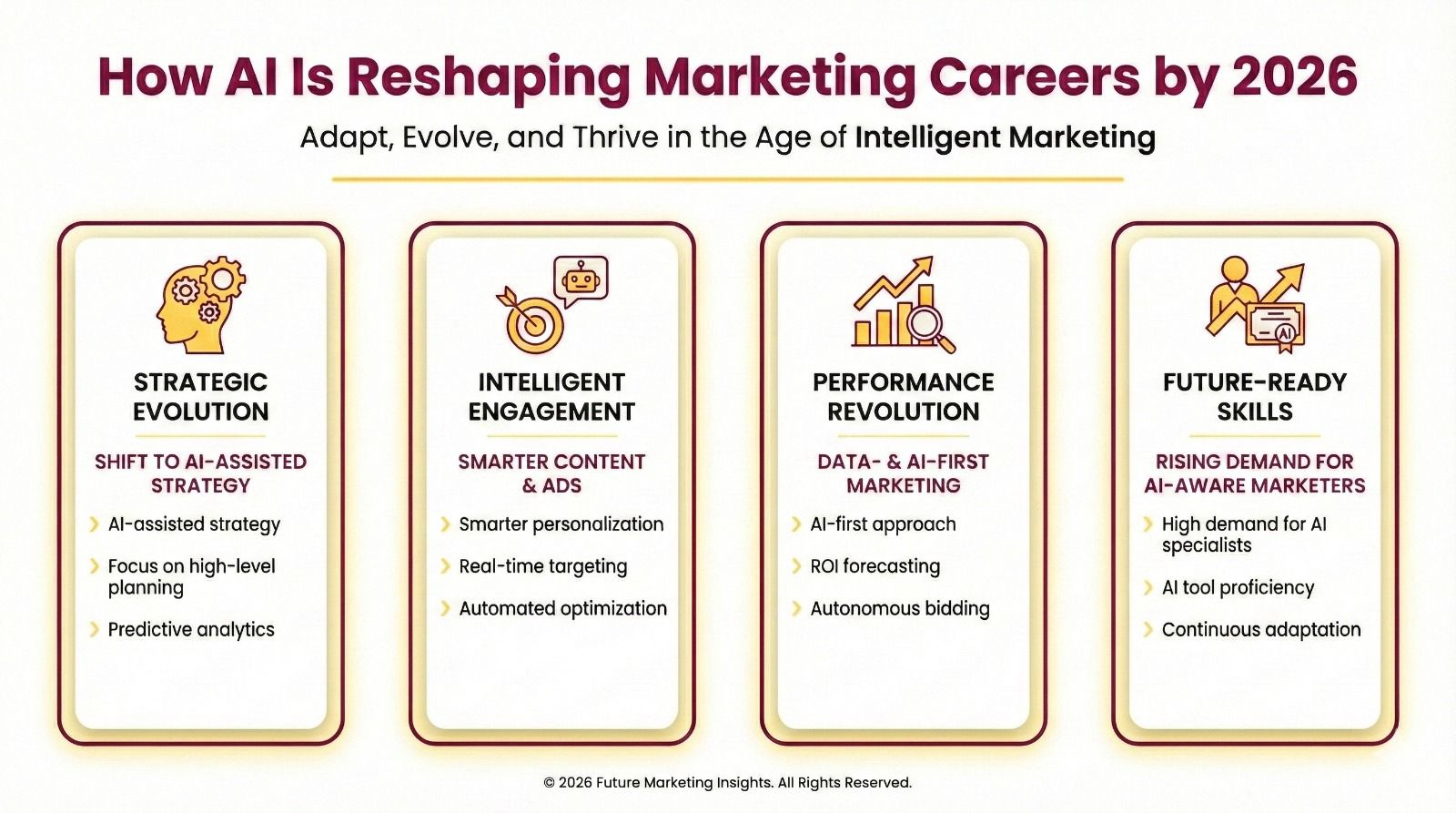
AI is fundamentally changing what marketing roles look like and how marketers deliver results. By 2026, marketers will be expected to combine creativity with AI-assisted decision-making, making productivity, personalization, and performance central to every role.
Here’s how AI is reshaping marketing careers:
● Shift from manual execution to AI-assisted strategy
○ AI automates repetitive tasks like keyword research, reporting, and audience segmentation
○ Marketers now spend more time on strategy, experimentation, and optimization
○ Entry-level roles increasingly focus on managing and interpreting AI outputs, not just execution
● Smarter content, ads, and personalization
○ AI tools help generate content ideas, ad copies, and creatives faster
○ Campaigns are personalized using real-time user data and behavior patterns
○ Marketers who understand how to guide AI tools produce better-performing campaigns
● Performance marketing becoming data- and AI-first
○ Paid ads, SEO, and email marketing rely heavily on AI-driven optimization
○ Budgets are adjusted automatically based on performance signals
○ Marketers are evaluated on outcomes like ROI, conversions, and growth – not just activity
● Rising demand for AI-aware marketers
○ Employers prefer candidates who can work alongside AI tools confidently
○ Roles such as performance marketer, growth marketer, and marketing analyst increasingly require AI exposure
○ As shown in AI marketing performance and ROI statistics, AI-powered marketing consistently improves efficiency and results
By 2026, marketing careers won’t replace humans with AI – but they will favor professionals who know how to use AI as a productivity multiplier. Students who start early will be better prepared for faster growth and stronger career opportunities.
AI Trends That Will Define Student Careers in 2026
AI is not just improving tools – it’s reshaping how careers are built. By 2026, students entering marketing and tech roles will be expected to understand and work with AI-driven systems as part of their everyday responsibilities. Knowing these trends early helps students prepare for what employers will actually demand.
Key AI trends shaping student careers include:
● AI-first workflows becoming standard
○ Tasks like research, content drafts, reporting, testing, and optimization are increasingly AI-assisted
○ Students who rely only on manual methods will struggle to match speed and efficiency
○ AI literacy will be treated as a basic skill, similar to spreadsheets or presentation tools
● Predictive and decision-support AI gaining importance
○ AI tools are moving beyond automation to forecasting outcomes
○ Marketing teams use AI to predict user behavior, conversions, and campaign performance
○ Tech teams use AI for performance prediction, system monitoring, and issue prevention
● Personalization at scale becoming a core expectation
○ AI enables hyper-personalized content, ads, and user experiences
○ Marketers are expected to understand how AI personalizes journeys across channels
○ Students who can guide AI toward better personalization gain a strong edge
● AI skills influencing hiring and career growth
○ Employers prefer candidates who show hands-on AI usage in projects
○ AI exposure improves internship selection and entry-level hiring chances
○ According to AI marketing statistics and predictions for 2026, AI adoption and reliance are expected to grow significantly across roles and industries
These trends make one thing clear: students who start learning and using AI tools early will be better positioned for faster growth, stronger job readiness, and long-term career stability in an AI-driven future.
Why Marketing and Tech Students Must Learn AI Early
Learning AI tools early is no longer about staying “ahead” – it’s about staying relevant. As AI becomes embedded in daily workflows, students who start early gain practical confidence, faster learning curves, and stronger employability across both marketing and tech roles.
Here’s why early AI exposure matters:
● Early learners build confidence, not dependency
○ Students who start with AI tools learn how to guide them, not blindly rely on outputs
○ They develop judgment – knowing what to accept, refine, or reject
○ This confidence shows clearly in projects, internships, and interviews
● AI accelerates learning and skill acquisition
○ AI tools help students understand concepts faster through examples and suggestions
○ Marketing students learn content, ads, and analytics quicker
○ Tech students speed up coding practice, debugging, and logic building
● Internships and entry-level roles already expect AI familiarity
○ Recruiters increasingly assume candidates have used AI tools
○ Students without AI exposure struggle to match productivity and pace
○ AI-aware students adapt faster to real workplace tools and processes
● AI skills improve long-term career growth
○ Early exposure helps students identify specializations sooner
○ AI-assisted workflows lead to better project outcomes and measurable impact
○ As highlighted in AI trends shaping the digital workforce, AI literacy is becoming a core requirement across roles – not a niche skill
Starting early doesn’t mean mastering AI overnight. It means building familiarity, comfort, and practical usage over time, a clear advantage for students preparing for 2026 and beyond.
Categories of AI Tools Every Student Should Understand
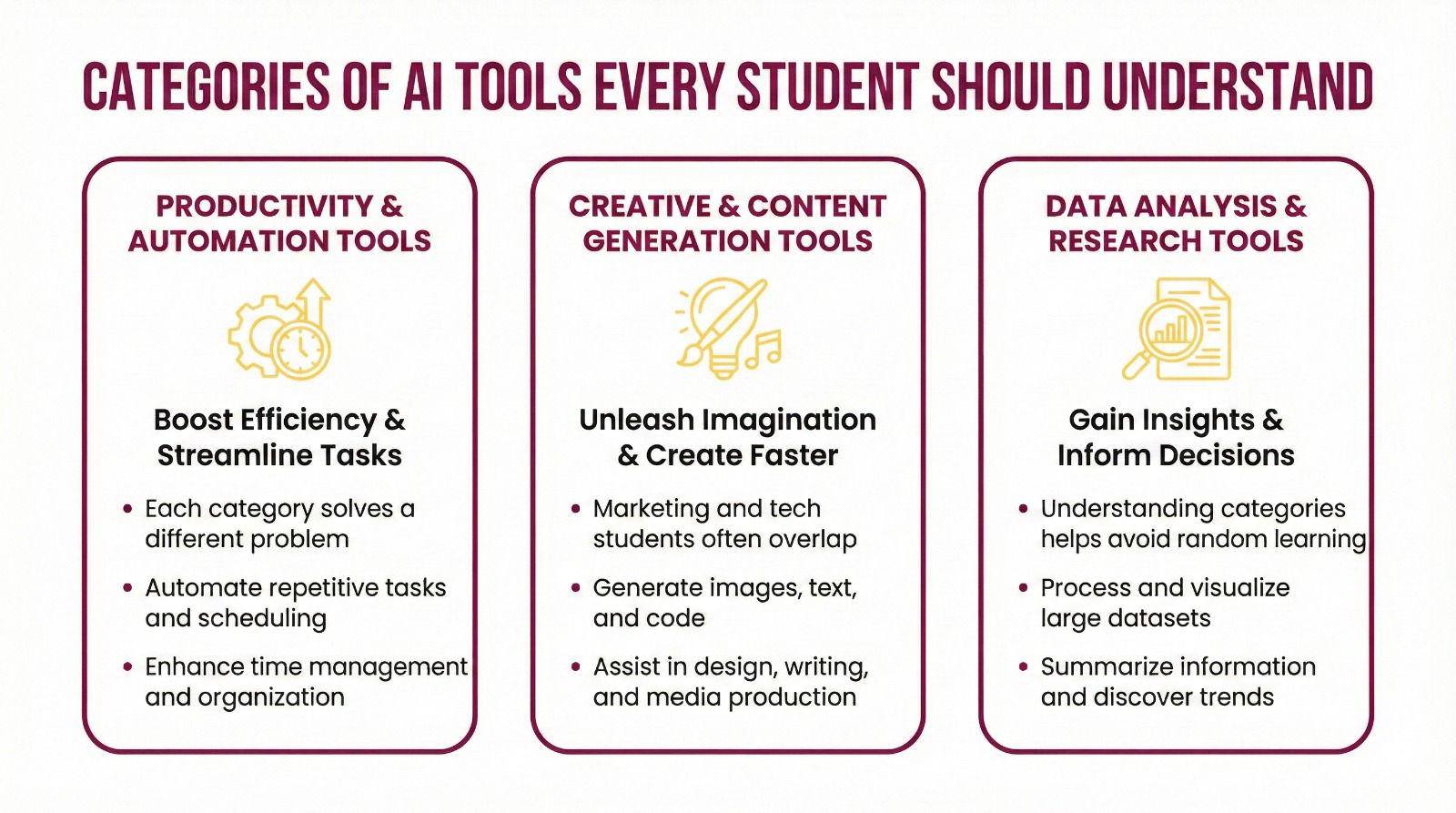
AI tools can feel overwhelming at first because there are so many options. The key for students is not to learn everything at once, but to understand the main categories of AI tools and how each category supports marketing or tech careers. Once this clarity is in place, choosing the right tools becomes much easier.
Here’s how AI tools are broadly categorized for students:
● Each category solves a different problem
○ Some tools help with creativity and content
○ Others focus on data, automation, or coding
● Marketing and tech students often overlap
○ Many AI tools are useful across both domains
● Understanding categories helps avoid random learning
○ Students can focus on tools that align with their career goals
AI Tool Categories and Career Relevance
| AI Tool Category | What It Helps With | Best Suited For |
|---|---|---|
| Content & Copy AI | Blogs, ads, emails, ideas | Marketing students |
| Design & Media AI | Images, creatives, videos | Marketing & creative roles |
| Analytics & Insight AI | Reports, trends, predictions | Marketing & data roles |
| Automation AI | Task and workflow automation | Tech & operations roles |
| Coding & Dev AI | Code suggestions, debugging | Tech students |
Why this matters for students:
● You don’t need to master every category
● Picking 2–3 relevant categories is enough to start
● Employers value practical understanding, not tool overload
By understanding these categories early, students can build AI skills in a structured way saving time, reducing confusion, and aligning learning with real career outcomes.
Must-Have AI Tools for Marketing & Tech Students
Knowing AI categories is helpful, but students gain real value when they start using specific AI tools that directly improve learning speed, project quality, and productivity. These tools are already used in internships and entry-level roles, making them essential for students preparing for 2026.
AI Tools That Directly Improve Student Productivity & Skills
For marketing and tech students, the right AI tools act as learning accelerators, not shortcuts. They help students understand concepts faster, execute tasks efficiently, and deliver better outcomes.
How these tools help students in practice:
● Speed up content creation, coding, and research
● Improve quality through suggestions and optimization
● Reduce time spent on repetitive tasks
● Help students focus on strategy, logic, and problem-solving
Below are the must-have AI tool types students should start using:
Must-Have AI Tools and Student Benefits
| AI Tool Type | Common Use Case | Skill Developed |
|---|---|---|
| Content & Writing AI | Blogs, ad copies, documentation | Content strategy |
| Design & Media AI | Images, creatives, videos | Visual communication |
| Analytics AI | Reports, insights, predictions | Data-driven thinking |
| Automation AI | Task and workflow automation | Productivity & efficiency |
| Coding AI | Code suggestions, debugging | Faster development |
For marketing students, these tools improve campaign planning, content quality, and performance analysis. For tech students, they enhance coding speed, logic building, and automation skills.
To explore real-world examples and current tools used by professionals, refer to Best AI tools for digital marketing. This helps students understand how these tools are applied in practical scenarios.
The goal isn’t to master every tool – but to use the right tools confidently, which is exactly what employers look for in 2026-ready candidates.
Skills Students Build by Using AI Tools Early
Using AI tools early does more than improve productivity – it helps students develop career-defining skills that employers actively look for. These skills go beyond tool familiarity and shape how students think, solve problems, and deliver results in marketing and tech roles.
Here’s how early AI exposure builds high-impact skills:
● Data-driven decision-making
○ Students learn to interpret insights instead of relying on assumptions
○ AI tools make it easier to analyze performance, trends, and outcomes
○ This builds confidence in making informed marketing and technical decisions
● Analytical and critical thinking
○ AI outputs require evaluation, refinement, and validation
○ Students learn to question results and improve prompts or logic
○ This strengthens problem-solving skills essential for real-world roles
● Automation and efficiency mindset
○ AI introduces smarter ways to handle repetitive tasks
○ Students focus more on strategy, creativity, and logic
○ This mindset aligns with how modern teams operate
● Adaptability to new technologies
○ Early AI users become comfortable learning new tools quickly
○ This adaptability is crucial in fast-changing marketing and tech environments
○ Employers value candidates who can evolve with technology
● Communication and presentation skills
○ Students learn to explain AI-driven insights clearly
○ This helps in reports, interviews, and stakeholder discussions
These skills strongly align with future-ready career expectations, as highlighted in 10 skills every digital marketer must learn in 2025. Students who build these competencies early don’t just use AI tools – they become professionals who know how to work smarter, faster, and with measurable impact.
How AI Tools Improve Placement & Interview Readiness
AI tools don’t just help students learn faster – they directly improve placement outcomes and interview performance. Recruiters increasingly look for candidates who can demonstrate practical AI usage, not just theoretical knowledge. For marketing and tech students, this makes AI tools a powerful career advantage.
Here’s how AI tools strengthen placement and interview readiness:
● Stronger project portfolios
○ AI tools help students build higher-quality projects in less time
○ Marketing students can showcase AI-assisted campaigns, content, and analytics
○ Tech students can present cleaner code, automation scripts, and optimized workflows
● Better interview answers with real examples
○ Students can explain how they used AI to solve problems
○ AI-backed examples show efficiency, creativity, and decision-making
○ This moves answers beyond theory to real-world application
● Improved confidence during technical and HR rounds
○ Familiarity with AI tools reduces hesitation when asked about productivity or workflows
○ Students can clearly articulate where AI fits – and where human judgment matters
○ This balance is highly valued by interviewers
● Alignment with recruiter expectations
○ Many interview questions now assess tool usage and practical thinking
○ Recruiters expect awareness of AI in marketing, analytics, coding, or automation
○ Candidates who mention hands-on AI usage stand out immediately
To prepare effectively, students should practice explaining their skills and projects clearly. Resources like mock interview questions and preparation help students understand what recruiters ask and how to frame AI-related answers confidently.
In today’s job market, AI tools don’t replace preparation they amplify it. Students who practice early are better positioned to convert interviews into offers.
Where Students Can Practice AI Tools Safely
Learning AI tools becomes effective only when students practice in the right environment. Randomly experimenting with tools without guidance can lead to confusion, incorrect usage, or unrealistic expectations. A safe, structured practice setup helps students learn faster and apply AI responsibly.
Here’s how students can practice AI tools the right way:
● Use guided learning environments
○ Structured platforms explain why a tool is used, not just how
○ Students learn correct prompts, workflows, and limitations of AI
○ This prevents blind dependence on AI outputs
● Practice with real-world scenarios
○ Simulated projects mirror marketing and tech use cases
○ Students learn to apply AI for content, analytics, automation, and coding
○ This builds confidence for internships and entry-level roles
● Access curated tools and learning materials
○ Avoids tool overload and confusion
○ Focus stays on tools that are relevant for careers, not trends
○ Students understand ethical and responsible AI usage
● Learn through feedback and iteration
○ Guided practice highlights mistakes early
○ Students improve prompts, logic, and decision-making
○ This mirrors how AI is actually used in professional teams
To support this kind of learning, platforms like WHY TAP Resources offer curated materials, tool guidance, and structured practice paths. These resources help students explore AI tools safely, build foundational confidence, and prepare for real-world application.
Practicing AI tools in the right environment ensures students don’t just use AI – but learn how to use it effectively and responsibly, which is exactly what employers expect.
Final Thoughts
AI tools are no longer just productivity boosters – they are becoming core career skills for both marketing and tech students. By 2026, employers will expect candidates to work confidently with AI to improve speed, accuracy, and decision-making. Students who start early gain more than tool familiarity; they build stronger thinking, better problem-solving abilities, and real-world readiness. Whether it’s content creation, analytics, automation, or coding support, AI tools help students learn faster and perform better. The key is not mastering every tool, but understanding how to use the right ones effectively and responsibly. Those who prepare now will stand out with confidence, relevance, and long-term career stability in an AI-driven job market.
Empower Your Career with WHY TAP
At WHY TAP, we help students and working professionals build future-ready skills through industry-focused AI Powered Digital Marketing programs. With expert mentors, hands-on projects, and strong placement support, you gain the confidence to grow faster in your career.
Start your career transformation with WHY TAP today.